





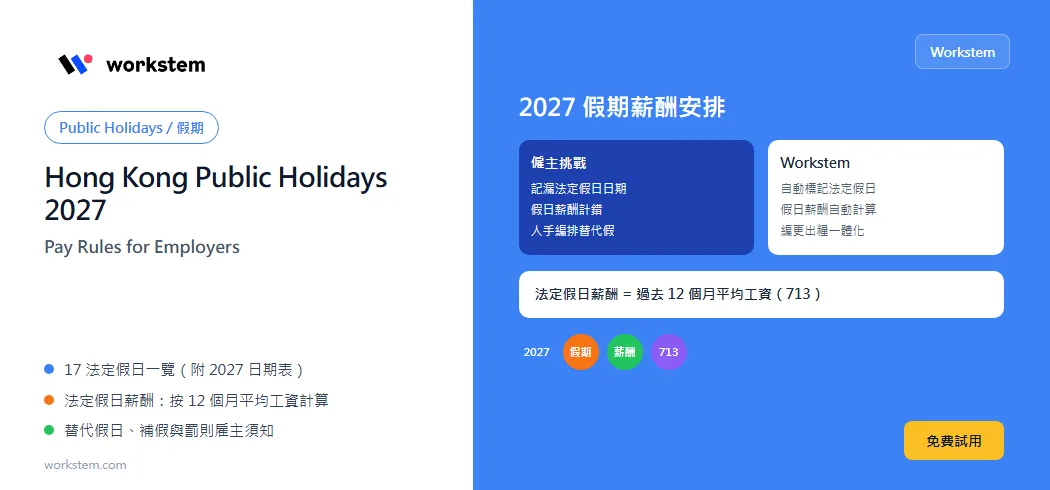
Hong Kong’s 2027 holiday calendar looks straightforward until you separate the 15 statutory holidays from the 17 general holidays—and then apply the Employment Ordinance’s pay rules to each. Statutory holiday pay is not simply “a day’s salary.” For any employee on a continuous contract for at least three months, it is the average daily wage (ADW) earned over the 12 months preceding the holiday, calculated under the 713 rule. Get the ADW wrong, and every statutory holiday in the year compounds the error.
This employer guide sets out the 2027 dates, the pay treatment for each category of holiday, and the payroll checks that matter most—including the 468 continuous contract threshold that took effect on 18 January 2026 and the MPF contribution caps that apply throughout 2027.
2027 Hong Kong Holiday Calendar: Statutory vs General at a Glance
Hong Kong runs two holiday lists in parallel. General holidays (17 in 2027, plus every Sunday) are the gazetted public holidays observed by banks, schools and government offices. Statutory holidays (15 in 2027) are the days every employee covered by the Employment Ordinance is legally entitled to, and they trigger statutory holiday pay for eligible continuous-contract employees.
| # | Statutory Holiday (15) | 2027 Date | Day |
General Holiday (17) |
| 1 | The first day of January | 1 January | Friday |
Yes |
| 2 | Lunar New Year’s Day | 6 February | Saturday |
Yes |
| 3 | The third day of Lunar New Year | 8 February | Monday |
Yes |
| 4 | The fourth day of Lunar New Year (substitute) | 9 February | Tuesday |
Yes |
| — | Good Friday | 26 March | Friday |
General only |
| — | The day following Good Friday | 27 March | Saturday |
General only |
| 5 | Easter Monday | 29 March | Monday |
Yes |
|
6 |
Ching Ming Festival | 5 April | Monday |
Yes |
| 7 | Labour Day | 1 May | Saturday |
Yes |
| 8 | The Birthday of the Buddha | 13 May | Thursday |
Yes |
| 9 | Tuen Ng Festival | 9 June | Wednesday |
Yes |
| 10 | HKSAR Establishment Day | 1 July | Thursday |
Yes |
| 11 | The day following Chinese Mid-Autumn Festival | 16 September | Thursday |
Yes |
| 12 | National Day | 1 October | Friday |
Yes |
| 13 | Chung Yeung Festival | 8 October | Friday |
Yes |
| 14 | Chinese Winter Solstice Festival or Christmas Day (employer’s option) | 22 December or 25 December | Wednesday or Saturday |
Christmas Day is a general holiday; Winter Solstice is statutory only |
| 15 | The first weekday after Christmas Day | 27 December | Monday |
Yes |
Key substitution: The second day of Lunar New Year 2027 falls on a Sunday, so the fourth day of Lunar New Year (9 February) is designated as the statutory holiday in substitution. Good Friday and the day following Good Friday are general holidays but not statutory holidays—employers are not required to grant them under the Employment Ordinance, though many employment contracts do.
Calendar image alt text: “2027 Hong Kong public holidays calendar showing 15 statutory holidays and 17 general holidays side by side.”
The Pay Rule That Governs Every Statutory Holiday: 713 and Average Daily Wage
Statutory holiday pay for an eligible employee is equivalent to the average daily wages earned in the 12-month period preceding the holiday. This is the 713 rule: since 13 July 2007, the old “last 28 days” method has been abolished for the eight statutory entitlements, including holiday pay, annual leave pay and sickness allowance.
| Element | How it works under 713 |
Why employers get it wrong |
| The formula | ADW = (Total wages in 12 months − excluded wages) ÷ (Total days in period − excluded days) |
Dividing total annual pay by 365 ignores excluded periods and understates or overstates ADW |
| “Specified date” | For statutory holiday pay, the specified date is the holiday itself |
Using a fixed calendar window instead of the 12 months ending on the day before each holiday |
| Excluded periods | No-pay or partial-pay periods (e.g. unpaid sick leave, maternity leave) and their wages are removed from both numerator and denominator |
Including unpaid weeks inflates the denominator and depresses ADW |
| What counts as wages | Salary, commissions, allowances, overtime pay and bonuses that are contractual or habitual |
Leaving commissions out of the ADW base for commission-earning staff |
The practical consequence: a January 2027 statutory holiday and a December 2027 statutory holiday may require different ADW figures, because the relevant 12-month windows differ. A system that calculates ADW once and reuses it across the year is not applying 713 correctly.
468 Continuous Contract: Who Qualifies for Holiday Pay in 2027
Statutory holidays themselves are entitlement for all employees covered by the Employment Ordinance. But statutory holiday pay requires the employee to have been employed under a continuous contract for not less than three months immediately before the holiday.
Since 18 January 2026, the continuous contract test is the 468 rule:
- the employee has been employed by the same employer for four weeks or more; and
- either works at least 17 hours in each week, or
- where a week falls below 17 hours, the total across that week and the preceding three weeks reaches 68 hours or more.
| Scenario | Continuous contract under 468? |
Statutory holiday pay implication |
| Full-time, 40 hours/week for 6 months | Yes |
Eligible for holiday pay on all 15 statutory holidays |
| Part-time, 15 hours/week for 8 weeks, but 62 hours across a rolling four-week block | No—below 68 hours and below 17 in at least one week |
No statutory holiday pay entitlement (statutory holiday itself still applies) |
| Part-time, 15 hours one week, 20 hours the next, totalling 70 hours across four weeks | Yes—the low week is caught by the 68-hour aggregate |
Holiday pay applies, calculated on ADW |
| Casual worker, hours fluctuate weekly between 10 and 25 | Depends on rolling four-week totals—must be tracked, not assumed |
Without hourly tracking, eligibility is guesswork |
The 468 change lowered the threshold from the former “418” rule (18 hours/week). Employers with part-time, casual or shift-based headcount now need four-week rolling hour totals, not just a weekly hours field, to determine who crosses the continuous contract line.
MPF and Statutory Holiday Months: What Changes on the Payslip
A statutory holiday month does not change the MPF contribution rules, but it changes the composition of relevant income on the payslip—and that is where errors appear.
For monthly-paid employees in 2027, mandatory MPF contributions remain 5% of relevant income, subject to:
- Minimum relevant income: HK$7,100 per month — employees below this threshold make no mandatory employee contribution, but the employer must still contribute 5%.
- Maximum relevant income: HK30,000permonth**—mandatorycontributionsarecappedat**HK1,500 per side per month (HK$18,000 per year).
| Monthly relevant income | Employee mandatory MPF | Employer mandatory MPF |
Payslip treatment in a statutory holiday month |
| Below HK$7,100 | HK$0 | 5% of relevant income (no statutory minimum contribution) |
Holiday pay is still wages; check whether it pushes relevant income over HK$7,100 |
| HK7,100–HK30,000 | 5% | 5% |
Holiday pay forms part of relevant income; contribution follows the same 5% |
| Above HK$30,000 | HK$1,500 (capped) | HK$1,500 (capped) |
Holiday pay does not change the capped contribution |
| Daily/weekly-paid | Daily cap: HK280–HK1,000 | Same daily cap range |
ADW-based holiday pay must be converted correctly for MPF purposes |
The MPF cap of HK$1,500 per side has remained unchanged while wages have risen, which means higher earners contribute a smaller percentage of salary than lower earners. For payroll teams, the compliance obligation is still binary: apply the correct cap, on the correct relevant income, every month.
IR56B and Holiday Pay: The Year-End Trail
Statutory holiday pay is taxable employment income. It must flow into the IR56B annual employer’s return, alongside wages, bonuses, allowances and MPF contributions. The IR56B is due within one month of the BIR56A being issued, typically around the start of April.
The operational risk is not the taxability rule—it is data fragmentation. If holiday pay is calculated in a payroll spreadsheet, MPF is reconciled separately, and IR56B is prepared from a third extract, the year-end return becomes a reconstruction exercise. A payroll system that calculates ADW-based holiday pay inside the same engine that produces the IR56B removes that reconciliation step: every statutory holiday payment is already tagged as wages, already included in the employee’s annual income record, and already available for the return.
How Workstem Handles 2027 Holiday Pay Inside the Payroll Engine
Workstem’s payroll software is built for Hong Kong’s statutory rules rather than adapted from a generic payroll product. For 2027 holiday pay, the relevant capabilities are:
| Workstem capability | What it does for 2027 holiday pay |
Where it matters |
| 713/ADW tracking | Tracks average daily wage and applies ADW in pay items, using the 12-month period preceding each specified date |
Statutory holiday pay, annual leave pay, sickness allowance |
| Built-in statutory holiday calendar | Loads the 2027 statutory and general holiday dates, with compliance baselines updated automatically |
Prevents wrong-date holiday pay and missed substitution days |
| 468 continuous contract monitoring | Uses attendance and rostering data to track rolling four-week hours against the 68-hour and 17-hour thresholds |
Part-time and casual holiday pay eligibility |
| MPF and eMPF | Calculates MPF with the HK7,100/HK30,000 monthly thresholds and HK$1,500 caps; supports eMPF submission |
Holiday-month contributions without manual rekeying |
| IR56B/E/F/G/M | Generates the IR56 series from payroll data and supports eTAX filing |
Year-end reporting that already includes holiday pay |
The distinction is not “automation” in the abstract. The statutory holiday pay calculation is the payroll calculation—the ADW, the 468 eligibility check, the MPF treatment and the IR56B record are produced from the same pay run, rather than from four separate processes stitched together at year-end.
FAQ
Q1: How many statutory holidays are there in Hong Kong in 2027, and how many general holidays?
There are 15 statutory holidays and 17 general holidays in 2027 (general holidays are in addition to every Sunday). Good Friday and the day following Good Friday are general holidays but not statutory holidays. The fourth day of Lunar New Year (9 February 2027) is a statutory holiday in substitution because the second day of Lunar New Year falls on a Sunday.
Q2: Is statutory holiday pay calculated on the last 28 days or 12 months?
12 months. Since the 713 amendment took effect on 13 July 2007, statutory holiday pay must be based on the average daily wage earned in the 12-month period preceding the holiday. The 28-day method no longer applies to the eight statutory entitlements covered by 713.
Q3: Does an employee on a continuous contract always get paid for statutory holidays?
Not automatically. The employee must have been employed under a continuous contract for at least three months immediately before the statutory holiday to be entitled to holiday pay. The statutory holiday itself—the day off—is a broader entitlement for employees covered by the Employment Ordinance.
Q4: What is the 468 rule, and does it apply to 2027 holiday pay?
The 468 rule is the continuous contract test in force since 18 January 2026: four weeks or more of employment, with either at least 17 hours per week or 68 hours across a rolling four-week period when a week falls below 17 hours. It applies to 2027 holiday pay because continuous contract status determines whether the three-month qualifying period can be met.
Q5: Do MPF contribution caps change because of statutory holiday pay?
No. The caps—**HK7,100minimumandHK30,000 maximum monthly relevant income, with mandatory contributions capped at HK$1,500 per side per month**—apply to relevant income as a whole. Statutory holiday pay is part of relevant income, so it can push an employee over the HK7,100thresholdortowardstheHK30,000 caps, but the caps themselves do not change because of the holiday.
Q6: Is statutory holiday pay included in IR56B?
Yes. Statutory holiday pay is taxable employment income and must be included in the IR56B annual employer’s return, which is due within one month of the BIR56A being issued. The practical challenge is ensuring the holiday pay figure in the payroll system matches the figure in the tax return—which is why calculating holiday pay inside the payroll engine, rather than alongside it, reduces year-end risk.
Why choose Workstem?
In many HR Systems in practice, the optimal solution is not necessarily the one with the most features or the highest price, but rather the one that best meets the actual needs of the enterprise. Workstem, as a 100% cloud-based solution...Human Resource Management SystemIt offers the following core advantages:
Full automation function
From attendance and payroll calculation to report generation, the entire process is seamlessly automated, significantly saving manual operation time.
Localization and Compliance Assurance
The system not only automatically updates the latest Hong Kong regulations and holidays, but also ensures that sensitive data is secure in accordance with ISO standards.
High scalability and integration capabilities
Provides an open API, enabling communication with…NetSuite、Xero, it seamlessly connects with other third-party applications to help enterprises achieve digital transformation.
Flexible trial and pricing strategies:
supply14-day free trialBusinesses can choose the appropriate version based on their actual operational needs, with options ranging from free to customized versions.
Workstem with these advantages, it has become the preferred human resource management solution for many Hong Kong companies.
(The content and information in this article are for reference only. Please refer to the latest government regulations for the accuracy and reliability of the information. This company does not provide any legal advice. If you wish to reprint this article or content, please contact our company first or include a link to this article and indicate the source.)
Related Glossary:
Further Reading
How to Choose a Payroll & HRM System?
Traditional HRM Software Vs Cloud HRM Software, Which One to Choose?
Workstem Customer Success Stories