


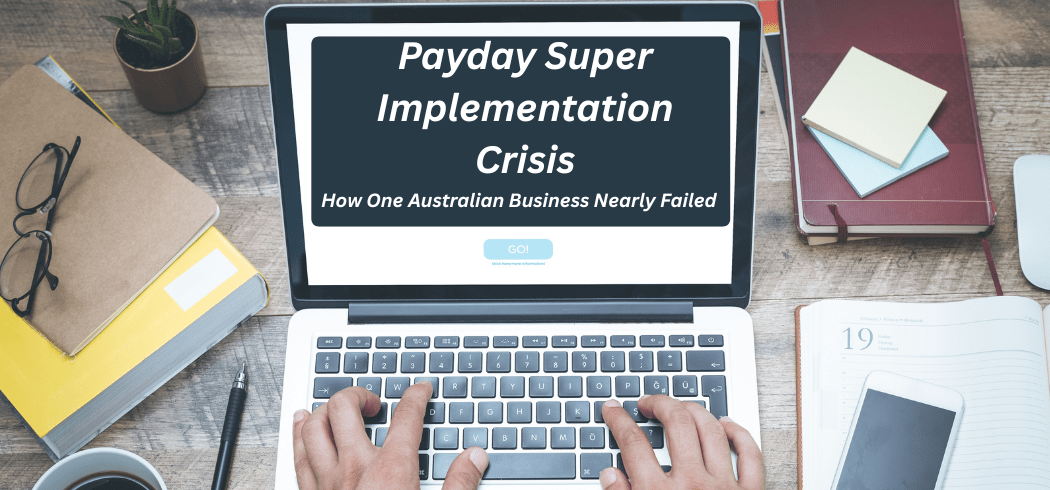
The transition to Australia’s new Payday Super regime has become a critical test for businesses nationwide. While designed to benefit employees, its implementation has exposed operational vulnerabilities in unprepared companies. This is the story of one Australian business that nearly collapsed under the weight of this new compliance burden and how they turned it into an opportunity for growth.
The Crisis: A Perfect Storm of Compliance and Cash Flow
The business, a mid-sized Melbourne-based logistics company with 85 employees, thought they were prepared for Payday Super. Like many, they used a legacy payroll system that processed superannuation monthly, aligning with their accounting cycles.
When the Payday Super implementation began, their system couldn’t cope. The mandate to pay super on each payday—sometimes weekly or fortnightly—created a cascade of problems:
- Manual Processing Overload: Their payroll team was forced to manually calculate and process super payments up to 12 times a month instead of once. This led to a 300% increase in administrative hours.
- Severe Cash Flow Strain: The shift from a single, predictable monthly super payment to multiple, smaller payments disrupted their carefully managed cash flow, creating unexpected liquidity challenges.
- Immediate Compliance Risks: The manual process was riddled with errors. They faced missed payment deadlines, incorrect calculation of Ordinary Time Earnings (OTE), and the immediate risk of penalties from the ATO.
They were on the brink of a full-blown compliance crisis, facing potential fines and a complete breakdown of their payroll function. This business failure was not due to a lack of market demand, but an operational collapse triggered by a new legislative change.
The Solution: Embracing Real-Time Payroll Integration
To survive, the company needed a technological solution. They implemented Workstem’s all-in-one payroll & HR system, specifically designed for the Australian market and Payday Super compliance.
The transformation was built on three key solutions:
- Automated Super Calculations: Workstem’s system automatically calculates super guarantee contributions based on OTE for each pay run, eliminating manual errors and saving countless hours.
- Direct STP Integration: The platform integrates seamlessly with the ATO’s Single Touch Payroll (STP) system. Every pay event is recorded in real-time, ensuring total transparency and compliance.
- Streamlined Payments: Workstem’s dashboard consolidates super obligations across all employees, allowing for easy verification and batch payment processing directly to super funds, meeting strict payday deadlines.
Before and After: A Data-Driven Transformation
The impact of switching to an automated, integrated system was dramatic.
| Metric | Before Payday Super (Legacy System) | After Payday Super (With Workstem) |
| Super Processing Time | ~20 hours per month (manual) |
< 2 hours per month (automated) |
| Payment Error Rate | Estimated 5-7% (high risk of penalties) |
0% (fully compliant) |
| Cash Flow Forecasting | Unpredictable, disrupted by multiple payments |
Clear and accurate, with real-time liability tracking |
| Compliance Status | High risk of ATO penalties |
100% ATO compliant with real-time STP reporting |
The business didn’t just avoid a crisis; they emerged more efficient, compliant, and with a stronger foundation for future growth. They turned a potential business failure into a strategic advantage.
How Workstem Simplifies Payday Super Compliance
Simplify award interpretation and payroll processing with Workstem, the all-in-one workforce management & payroll software designed for every industry.
Workstem‘s automated payroll platform is engineered for the Payday Super Australia 2026 era. We transform this regulatory change from a challenge into an opportunity for efficiency.
- Auto-Calculate Super: Accurately compute liabilities for every pay cycle, every time.
- One-Click SuperStream Payments: Submit and pay super contributions directly to funds with a single action.
- Centralised Employee Management: Keep all super fund details secure, up-to-date, and easily accessible.
- Ensure Unbroken Compliance: Maintain a clear, digital audit trail for every transaction, ready for reporting.
Choose from our Standard or Advanced plan to suit your business needs, and stay Fair Work compliant with confidence.
Payday Super Q&A: Your Top Questions Answered
Q1: What is the exact start date for Payday Super?
A: The government has announced a start date of 1 July 2026. Legislation to enact this change is expected to be introduced in Parliament during 2025.
Q2: Does Payday Super apply to all businesses?
A: Yes. The new rules will apply to all Australian employers, regardless of size or industry. This includes small businesses, sole traders with employees, non-profits, and government entities.
Q3: What happens if I pay my employees early, but their super is paid on the official payday?
A: The law requires super to be paid on the same day as salary and wages. If you pay wages early, your super contribution must also be made on that same early date. The key is simultaneity.
Q4: How does Payday Super affect my cash flow?
A: Instead of one large quarterly payment, you will make smaller, more frequent payments. This requires more active cash flow management but can prevent the burden of a significant quarterly outlay. Forecasting is essential.
Q5: Will the Super Guarantee (SG) rate still be increasing?
A: Yes. The SG rate is legislated to continue rising to 12% by 2025. Payday Super is a separate reform about the timing of payments, not the rate.
Q6: What are the penalties for non-compliance?
A: The ATO will have enhanced visibility through the real-time system. Penalties for late or unpaid super will still apply, including the Super Guarantee Charge (SGC), which is not tax-deductible and includes interest and administration fees.
Q7: Can I use a transition period to adjust?
A: The government has indicated a phased approach to allow software developers and businesses time to prepare. However, all employers are expected to be fully compliant by the 1 July 2026 deadline.
Q8: How does Payday Super work with my current payroll software?
A: You must check with your provider. Older or basic software may not support the automated, SuperStream-integrated payments required. Modern, compliant platforms like Workstem are being updated to handle these changes seamlessly.
Book a free demo with our payroll experts and experience how Workstem can streamline your payroll and workforce operations.
Read More:
How Pay Day Super Affects Your Business