


Every permanent employee in Australia is entitled to paid annual leave. But many workers and even some employers don’t know exactly how much leave they’ve accrued, or how to calculate it correctly.
This guide covers your leave entitlements Australia under the National Employment Standards (NES), explains how accrual works, and shows you how to use an annual leave calculator to track your balance.
Who gets annual leave in Australia?
What: Paid annual leave is a minimum entitlement for all full-time and part-time employees under the Fair Work Act 2009.
Who: All permanent employees including full-time and part-time are entitled to annual leave. Casual employees do not accrue paid annual leave; instead, they receive a 25% casual loading in lieu.
When: Annual leave begins accruing from your first day of employment, even during a probation period.
Where: These rules apply nationally under the NES, regardless of which state or territory you work in.
Why: The NES sets the legal floor for employment conditions in Australia, ensuring all workers have access to paid rest.
How: Leave accrues progressively throughout the year — you don’t have to wait until the end of the year to access it.
How much annual leave are employees entitled to?
Under the NES:
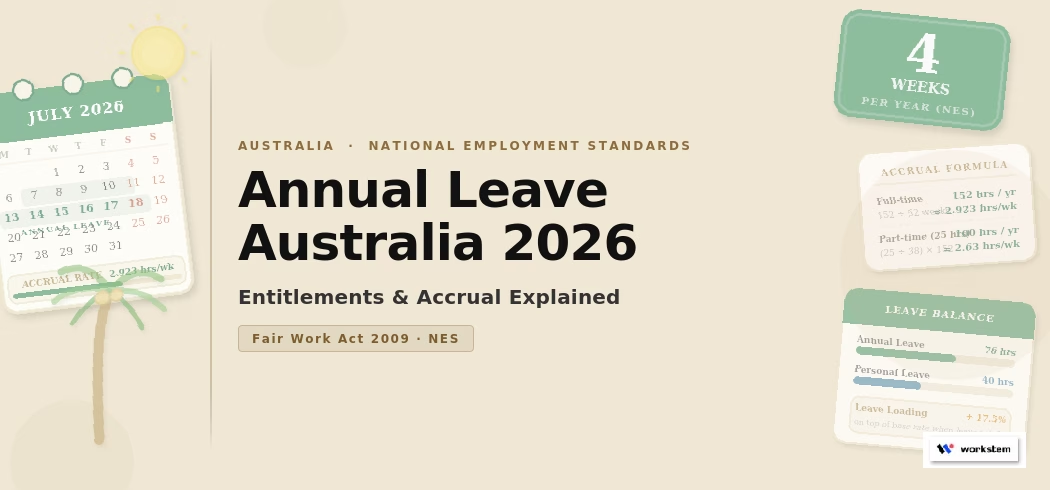
- Full-time employees: 4 weeks (20 days / 152 hours) per year
- Part-time employees: Pro-rata based on contracted hours
- Shiftworkers: Up to 5 weeks per year (award-dependent)
Unused annual leave rolls over from year to year. There is no expiry or “use it or lose it” rule under the NES — though some awards and enterprise agreements may allow employers to direct employees to take leave if a balance becomes excessive.
How does annual leave accrue?
Annual leave accrues at a rate of 2.923 hours per week for full-time employees working a standard 38-hour week.
Formula:
152 hours ÷ 52 weeks = 2.923 hours per week
For part-time employees, the formula is:
(Weekly contracted hours ÷ 38) × 152 = Annual entitlement in hours
Example: An employee working 25 hours per week accrues (25 ÷ 38) × 152 = 100 hours per year, or approximately 2.63 hours per week.
What is leave loading?
Many award-covered employees are entitled to 17.5% leave loading which is an additional payment on top of their base rate when they take annual leave. Not all employees receive this; it depends on your award or enterprise agreement.
Check your Modern Award or EA to confirm whether you’re entitled to leave loading.
How to calculate annual leave balance?
Use this step-by-step approach or an online annual leave calculator:
- Find your opening balance — check your most recent payslip.
- Calculate new accrual — multiply weeks worked since your last payslip by your weekly accrual rate (2.923 hrs for full-time).
- Subtract leave taken — deduct any annual leave used during the period.
The Fair Work Ombudsman’s PACT leave calculator provides an official, free tool for employees and employers or use our free annual leave calculator.
What happens to annual leave when employees leave a job?
All unused annual leave must be paid out on termination at your ordinary hourly rate (plus leave loading if applicable under your award). This applies regardless of whether you resign, are made redundant, or are dismissed.
Key Takeaways
- Full-time employees accrue 4 weeks (152 hours) of paid annual leave per year under the NES.
- Accrual starts from day one of employment, including during probation.
- The accrual rate is 2.923 hours per week for full-time staff; pro-rata for part-time.
- Casual employees are not entitled to annual leave but receive a 25% loading instead.
- Always use the official PACT tool or an up-to-date annual leave calculator for accuracy.
Source: National Employment Standards, Fair Work Act 2009
FAQs about Annual Leave Australia in 2026
Q1: How much annual leave do employees accrue per week in Australia?
A1: Full-time employees working a standard 38-hour week accrue 2.923 hours of annual leave per week under the National Employment Standards. This equals 152 hours (4 weeks) over a full year. Part-time employees accrue on a pro-rata basis: divide contracted weekly hours by 38, then multiply by 152 to find the annual entitlement. For example, an employee working 20 hours per week accrues 80 hours (approximately 2 weeks) of annual leave per year.
Q2: Does annual leave accrue during sick leave or unpaid leave?
A2: Annual leave continues to accrue during paid personal/carer’s leave (sick leave) and paid parental leave funded by the employer. However, leave generally does not accrue during periods of unpaid leave, including unpaid parental leave and any unpaid absence, unless your award or enterprise agreement specifically states otherwise. If employees are being paid under the government’s Paid Parental Leave Scheme while on unpaid leave, annual leave does not accrue during that period.
Q3: Can employers force employees to take annual leave in Australia?
A3: Yes, in limited circumstances. Under the Fair Work Act 2009, an employer can direct an employee to take annual leave if the employee has an excessive leave balance (generally defined in the applicable Modern Award as more than 8 weeks) or during a genuine business shutdown period, such as Christmas. The employer must give the employee reasonable notice usually at least 4 weeks and the direction must comply with the applicable award or enterprise agreement.
Q4: What happens to unused annual leave when an employee resigns?
A4: All accrued but untaken annual leave must be paid out in full on termination, regardless of whether you resign, are dismissed, or are made redundant. The payout is calculated at the ordinary rate of pay at the time of termination, plus any applicable leave loading (17.5% for award-covered employees where the award provides for it). This payout is a legal entitlement under the NES and employers cannot withhold it.
Q5: Can employees cash out annual leave without taking time off?
A5: Yes, but only under specific conditions. Under the NES, an employee can cash out annual leave if their Modern Award or enterprise agreement permits it, they have a genuine written agreement with their employer to do so, they retain a minimum balance of 4 weeks of accrued leave after the cash-out, and they are paid the full monetary value of the leave cashed out, including any applicable leave loading. Employers cannot pressure or require an employee to cash out annual leave.
Read More
HR Tools & Calculators
Australian Annual Leave Calculator
Annual Leave Overview
Annual Leave & Sick Leave Pay Calculations
Unlocking Annual Leave: The Ultimate Guide
Leave Entitlements Guide
HR Insights & Resources
Leave Management Software vs. Excel: Which is More Effective?
Discover the Benefits of Leave Management Software: Say Goodbye to Excel!