


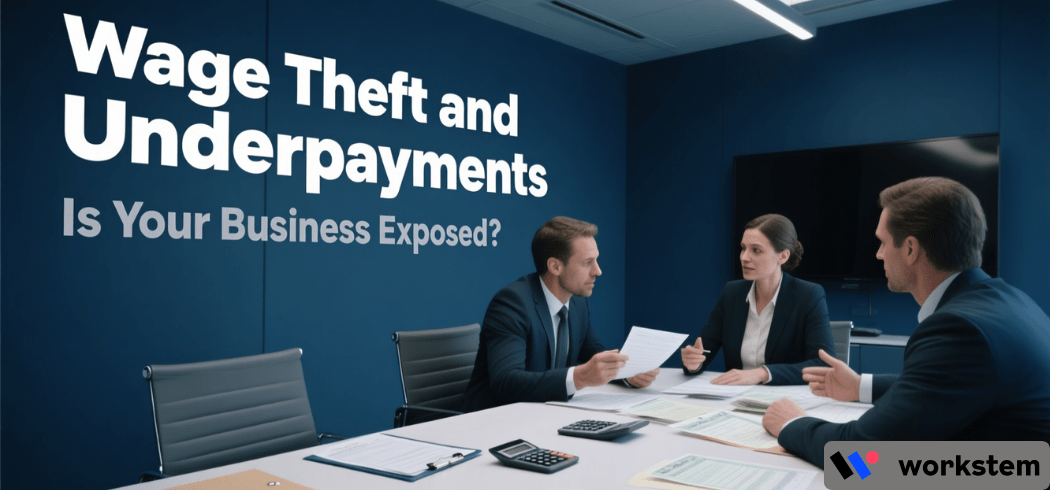
Wage theft and underpayments occur when a business fails to pay employees the full wages and entitlements owed. In Australia, this has become a very serious compliance issue. Under new laws from January 2025, intentional underpayment of wages is a criminal offence. Employers who deliberately withhold pay or fail to keep accurate payroll records can face massive fines and even jail time. For example, recent legislation imposes penalties of up to 10 years’ imprisonment for individuals and millions of dollars for companies.
What is wage theft and how does it occur?
Wage theft is more than a payroll error, it often involves knowingly paying less than the legal minimum, falsifying pay records, or failing to keep accurate employee time logs. Under Victoria’s new Wage Theft laws, offences include “dishonest” withholding of pay and falsification of records. Even outside Victoria, the federal Fair Work Act now treats deliberate underpayments as criminal conduct. This means that any intentional failure to pay wages, penalty rates or superannuation on time could be prosecuted.
Who can be charged?
Both companies and individuals are at risk.
- Corporate officers (directors, managers, payroll officers) can be held personally liable if they are shown to have known about or been “reckless” in allowing underpayments.
- Companies face fines up to the greater of $8.25 million or three times the underpaid amount; individuals face up to 10 years’ jail and up to $1.65 million (or 3× the underpayment).
Even unintentional errors may lead to penalties: small businesses can avoid criminal referral only if they demonstrate they followed a prescribed compliance code.
Why have penalties increased?
Regulators have signaled a zero-tolerance approach. In 2023–24 the Fair Work Ombudsman secured the highest penalties in its history, collecting over $473 million in back-payments for 160,000 workers. Major litigation included a $10.3 million fine against a bank and multi-million penalties against restaurant chains. These outcomes show that courts are imposing huge fines to deter non-compliance.
How can my business stay safe?
Proactive measures are crucial. Employers should:
- Audit payroll systems regularly
- Making sure employees are paid according to the latest awards/agreements
- Keep meticulous records
- Use reliable tools or certified payroll software to automatically calculate wages and flag an.
- Train managers on entitlements (overtime, leave loading, allowances) and maintain open reporting channels for staff concerns.
- If an underpayment is discovered, immediately self-report to the Ombudsman and back-pay the correct amount. (Experts note that immediate back-payment and cooperation with the Ombudsman can often avoid further penalties)
Key preventative steps: Maintain up-to-date payroll records (time sheets, payslips, super records); cross-check pay rates against modern awards; implement an internal review process; and stay informed of legal changes. Ensuring “due diligence” can show that any mistake was not intentionall.
How Workstem Simplifies Payroll Compliance
Simplify award interpretation and payroll processing with Workstem, the all-in-one workforce management & payroll software designed for every industry. Our system supports 122+ modern awards & 34 EAs, and keeps you up-to-date with changes in wage rates, penalty rates, and overtime rules.Workstem offers:
- Automated award interpretation
- Real-time wage calculations and timesheet syncing
- Employee self-service app for rosters and payslips
- Seamless integrations with Xero, NetSuite, and more
Choose from our Standard or Advanced plan to suit your business needs, and stay Fair Work compliant with confidence.
Book a free demo with our payroll experts and experience how Workstem can streamline your payroll and workforce operations.
FAQs About Payroll Compliance
Q1: Can an honest mistake be treated as wage theft?
A1: Generally, isolated mistakes are handled civilly. Wage theft laws target intentional or reckless underpayments. Showing you took reasonable steps to pay correctly (e.g. using updated rates and audits) helps avoid criminal exposure.
Q2: What triggers a criminal investigation?
A2: Repeated or large underpayments, falsified payslips, or ignoring back-payment requests can all trigger criminal investigation. Regulators will look for “dishonest” conduct or a culture of non-compliance.
Q3: Is my business considered “small”?
A3: Businesses with fewer than 15 employees may qualify for a Small Business Code safe harbor, but only if failures were truly unintentional and all corrective steps were taken.
Q4: Which industries are most vulnerable to wage theft laws?
A4: Hospitality, retail, aged care, cleaning, and security are among the most common industries facing wage theft cases.
Q5: How can businesses reduce the risk of wage theft charges?
A5: By using compliant payroll software, training managers, conducting payroll audits, and keeping accurate records.
Read More: