


Payday Super changes when cash must leave your business. Instead of funding super contributions on a quarterly schedule, employers must generally pay them in line with each payday, while ensuring the relevant funds receive those contributions within the statutory timeframe.
For a business with weekly or fortnightly payroll, that means super is now a recurring cash-flow obligation that must be planned alongside wages and other operating costs.
The solution is to forecast super at every pay cycle, allow for payment processing time and resolve exceptions before they become ongoing shortfalls. Understanding the seven-business-day rule and the Super Guarantee Charge (SGC) is essential to building that process.
What is the 7-day rule for Payday Super?
The 7-day rule generally requires an employee’s super fund to receive the relevant contribution within seven business days after the payday on which the qualifying earnings are paid. The obligation is not satisfied simply because a payroll file has been generated or a payment has been authorised.
Under Payday Super, which commenced on 1 July 2026, SG is generally calculated at 12% of qualifying earnings. The applicable deadline can be extended in specified circumstances, including certain first contributions for new employees and other legally defined situations.
Does the deadline start when finance submits the payment?
Employers should manage the process against the relevant fund receipt deadline, not just the date the bank transfer is done.
The practical sequence is:
- Payroll calculates qualifying earnings and the associated SG liability.
- The payment is prepared, checked and authorised.
- The bank, payment provider or clearing house processes the contribution.
- The super fund receives the contribution within the applicable period.
- Payroll or finance checks for failures and corrects exceptions.
The earlier the process starts, the more time remains to fix errors. A business that routinely waits until the end of a payment window has fewer options if a transaction is rejected or delayed.
How does Payday Super affect business cash flow?
Payday Super reduces the time employers have to hold cash that is owed as super, so finance teams should forecast liabilities by pay cycle rather than by quarter.
The impact depends on the workforce, the size of the payroll, pay frequency and the existing payment process. Weekly payroll creates more frequent funding events than monthly payroll, even where the annual earnings total is the same.
Consider this illustrative calculation:
| Item | Amount |
| Qualifying earnings for one pay run | $5,000 |
| Applicable SG rate | 12% |
| SG contribution for that pay run | $600 |
This example assumes an employee’s $5,000 is qualifying earnings and the ordinary 12% rate applies. The $600 is a liability associated with that pay run, not money that should be treated as available working capital.
For a business running multiple payrolls across locations, entities or pay frequencies, the finance team should aggregate the expected liabilities while preserving each payroll’s individual due dates and payment records.
How should employers forecast super payments?
Build a rolling forecast that combines payroll schedules, expected qualifying earnings and payment timing. Update it when headcount, pay frequencies, bonuses or other earnings change.
Use the table below as a guide when having to do a forecast:
| Forecast item | What the finance team should record |
| Upcoming payday | The date wages are paid |
| Expected qualifying earnings | The total qualifying earnings for that pay run |
| Forecast super liability | Qualifying earnings × applicable SG rate |
| Expected customer receipts | Invoices expected to be collected before payment deadlines |
| Other cash commitments | Wages, supplier invoices, rent and other scheduled expenses |
| Payment status | Whether contributions are pending, completed or require correction |
Where cash is tight, escalate funding constraints before payday. Delaying a contribution because cash was not reserved can create a compliance issue even if the payroll calculation itself is correct.
What happens if super is paid late under Payday Super?
If an employer has a super guarantee shortfall, the SGC framework can apply. Correcting a late contribution is important, but a late payment does not automatically remove the potential charge.
The reformed SGC framework links contributions to qualifying earnings and the relevant payment day. The amount payable can include the applicable shortfall, notional earnings and an administrative uplift.
Under the legislation and the ATO’s compliance guideline, later contributions may reduce the shortfall-related amount, but late contributions alone do not necessarily reduce the charge to nil.
This is why payment records and prompt corrections matter. Employers need to know not only what was paid, but whether the contribution was sufficient and received within the applicable period.
Does the ATO’s first-year approach mean late super is safe?
No. The official guide covers qualifying earnings days between 1 July 2026 and 30 June 2027. It clearly shows how the ATO will prioritise compliance resources, recognising that some employers may experience genuine implementation issues.
It places importance on whether employers attempt (genuinely!) to pay super in line with Payday Super and how promptly they correct problems. Employers who continue paying quarterly without moving towards the new requirements cannot assume they will be treated as low risk.
A compliant operating process remains the objective, even when an employer is making a genuine effort to correct a mistake.
What should a Payday Super cash-flow dashboard show?
A useful dashboard shows upcoming liabilities and unresolved exceptions together. A figure showing total super payable is insufficient if the finance team cannot identify when individual contributions need to reach their funds.
| Dashboard measure | Why it matters |
| Expected SG by pay run | Forecasts the cash required for upcoming payrolls |
| Contribution due date | Shows the applicable deadline for each contribution |
| Paid, pending and rejected status | Highlights unresolved payment issues |
| Outstanding corrections | Assigns priority to amounts that still need action |
| Payment history by employee and fund | Helps trace discrepancies to their source |
| Reconciliation differences | Flags gaps between payroll, reporting and transaction records |
How can payroll software improve Payday Super cash-flow management?
Payroll software can help by calculating SG during each pay run, providing visibility of expected contributions and maintaining payment records. Integrations and exception reporting can also reduce manual reconciliation, provided the system is configured correctly.
Workstem’s Payday Super solution supports QE-based calculations, contribution processing and reporting. Employers evaluating software should confirm how payment status, exception handling and their own banking arrangements work together in practice.
Review your payday funding and contribution workflow with Workstem to see how payroll and super processes can be brought together.
Frequently asked questions
1. Is super due on payday or within seven business days?
The statutory framework generally requires super to be paid in line with payday, with contributions reaching the relevant fund within seven business days after the payday. The allowable payment period depends on the circumstances and specific exceptions.
2. Can an employer pay super late if the cash flow forecast is wrong?
A cash-flow problem does not automatically extend the statutory deadline. Employers should arrange funding in advance and seek appropriate professional advice if they identify a possible shortfall.
3. Can a late super payment remove an SGC liability?
Not necessarily. Making a late contribution can reduce the relevant shortfall, but the SGC can include additional components that are not automatically eliminated by paying the contribution later.
4. How should finance teams prepare for Payday Super?
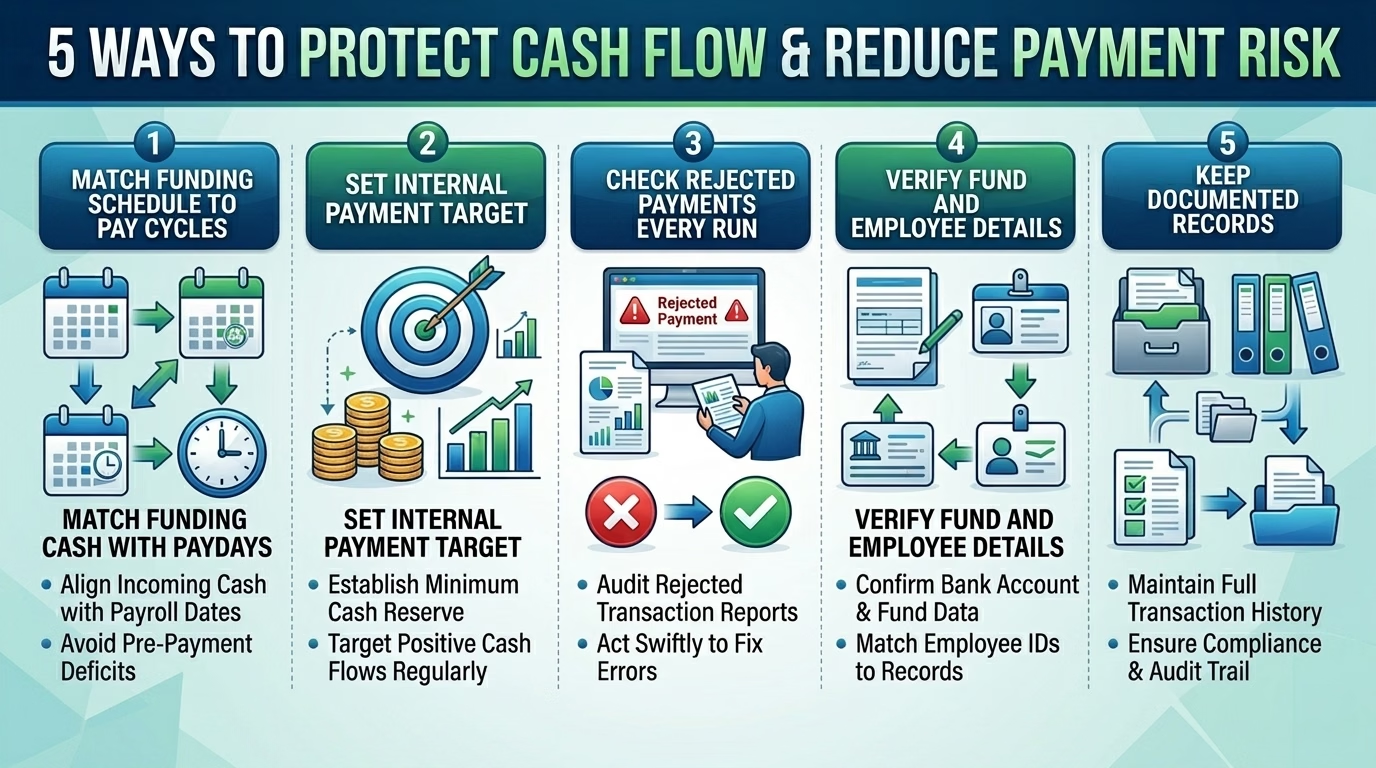
Use a cash-flow forecast, reserve super at each pay cycle, set internal payment targets, monitor any rejected transactions and fix payment outcomes against payroll and STP records.
Read more
More Payday Super related articles
Payday Super Rejected Payments: What Employers Should Do
What Actually Breaks Payday Super: 7 Operational Failure Points
MVR Explained for Employers: What Happens Before Super Is Sent
Payday Super ATO Risk Zones Explained: How to Stay Low Risk
Payday Super for New Employees: How the 20-Business-Day Rule Works