


Most of the Payday Super conversation is about what happens after payday, mainly the 7-day deadline, the Super Guarantee Charge, getting money to funds on time. But one of the most useful changes happens before a cent moves: the Member Verification Request, or MVR.
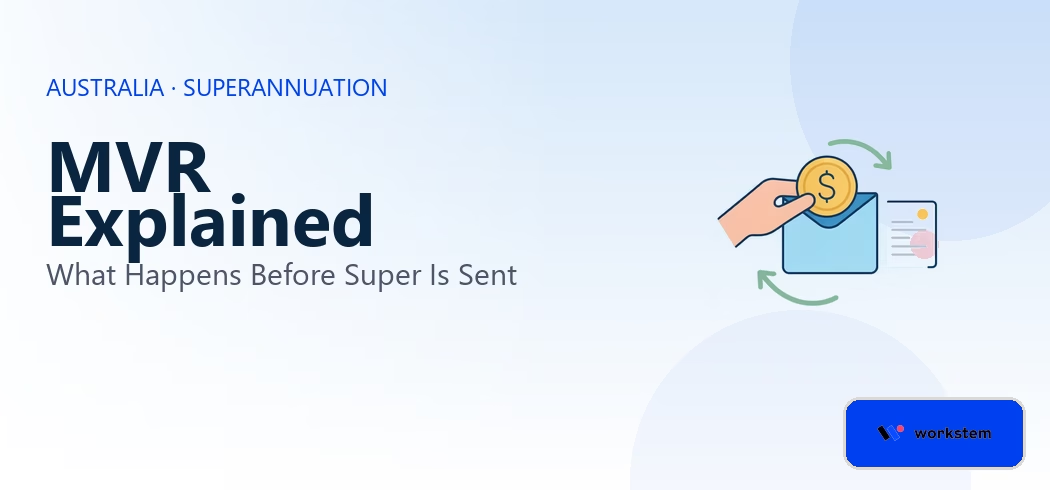
In plain terms, an MVR is a quick digital check with a super fund that answers two questions before you pay: is this employee actually a member of this fund, and can the fund accept a contribution for them? Get a “yes” first, and the first payment goes through cleanly. Skip the check, and you find out something was wrong only after the contribution bounces which, under Payday Super’s tight timing, is exactly when you can least afford it.
What is a Member Verification Request (MVR)?
The MVR is a new digital message introduced as part of the upgraded SuperStream framework (Contributions version 3.0) that underpins Payday Super. It lets an employer go through their payroll software or clearing house and ask a super fund to confirm two things before a contribution is made: that the employee is a member of the nominated fund, and that the fund can accept contributions for that member.
Think of it as a pre-flight check. Its whole job is to make sure the right money can go to the right member at the right fund, before the payment is sent rather than after.
Why does the MVR exist?
Under the old quarterly system, a contribution sent to the wrong fund or with mismatched member details would be rejected and refunded and you had weeks to sort it out before the quarterly deadline. Under Payday Super, that same rejection goes into a 7-business-day window, and a bounce discovered late can push you past the deadline and into Super Guarantee Charge penalty.
The MVR is designed to catch those errors before they happen. By confirming fund and member details up front, it cuts down the rejected and refunded contributions that would otherwise create late-payment risk and reduces the manual error-chasing that lands on payroll teams after the fact.
When to trigger an MVR and when not to?
The MVR is built around a “first-time contribution” principle. You use it when you’re about to contribute to a fund for an employee for the first time, or when something has changed that affects where the money goes. In practice, that means two main triggers:
A new employee, where you’re verifying the fund details for someone you’ve never paid super for before. And an employee changing funds, where you’re about to make a first contribution into a new fund for an existing employee.
You don’t fire an MVR on every payday for every employee. Once a fund and member have been verified and you’re contributing successfully, routine ongoing contributions don’t need re-verification each cycle. Overusing MVRs just adds administrative load without reducing risk, the value is at the first contribution, where mistakes actually happen.
How the MVR flow works?
The sequence is straightforward. Your payroll system or clearing house sends an MVR message to the employee’s nominated fund. The fund checks the details it holds, typically the member’s name, date of birth, and tax file number against what you’ve supplied. It then sends back a response confirming whether the member is verified and the fund can accept contributions. From 1 July 2026, funds are expected to respond within 24 hours.
If the response is a match, you proceed to make the contribution with confidence that it won’t bounce on a detailed error. If it isn’t, you fix the problem before any money moves, which is the entire point.
What happens when an MVR fails?
A failed verification usually comes down to a data mismatch. The common reasons are a tax file number mismatch (the TFN you supplied doesn’t match what the fund holds), a member not found (no TFN was included and the fund couldn’t match the person on other details), or a name or date-of-birth discrepancy.
When that happens, the fix is to reconcile the details, check the employee’s records against the fund’s, correct whatever is wrong, and submit a fresh MVR. Because this all happens before the contribution, a failed MVR is an inconvenience you resolve quietly, not a late payment you have to remediate. That’s the whole advantage: it moves error handling to before payday, where it’s cheap, instead of after, where it costs you the clock.
When will MVR become mandatory?
There’s a transition here worth understanding. The MVR is not mandatory from day one. Super funds have until March 2027 to implement the capability, and many payroll providers, clearing houses, and funds are rolling it out through the second half of 2026.
Until your systems are MVR-ready, you can continue with your existing SuperStream processes provided you still meet the Payday Super timing requirements. But the direction is clear: once MVR is available in your systems, you’ll be expected to verify fund details before making a first contribution. Treating data quality and verification as a habit now means the mandate isn’t a scramble later.
Why the MVR matters for your 7-day timeline?
The MVR looks like a small technical step, but it protects the thing that matters most under Payday Super: time. Every rejected contribution you prevent is a 7-day window you don’t waste chasing a correction. For new joiners especially where fund details are fresh and most likely to be wrong, verifying before you pay is the difference between a clean first contribution and a Super Guarantee Charge risk on someone’s very first pay run.
Ready isn’t the same as right. A payroll system that can send contributions isn’t fully Payday Super-ready unless it can also verify them first so it’s worth asking your payroll and clearing house providers exactly where MVR, and the wider SuperStream v3 upgrade, sits on their roadmap.
FAQs About the Member Verification Request
Q1: What does MVR stand for?
A1: MVR stands for Member Verification Request. It’s a new SuperStream (version 3.0) digital message that lets an employer confirm an employee’s super fund and member details before making a contribution.
Q2: What is the purpose of an MVR?
A2: To check, before money is sent, that the employee is a member of their nominated fund and that the fund can accept a contribution for them. This prevents rejected or refunded contributions that could otherwise cause late payments under Payday Super’s 7-business-day rule.
Q3: When should I use an MVR?
A3: Use one for a first-time contribution typically when onboarding a new employee, or when an existing employee changes their super fund. You don’t need to send an MVR for routine ongoing contributions to a fund that’s already been verified.
Q4: How quickly do funds respond to an MVR?
A4: From 1 July 2026, funds are expected to respond to an MVR within 24 hours.
Q5: Is MVR mandatory from 1 July 2026?
A5: No. Funds have until March 2027 to implement MVR, and many providers are rolling it out through the second half of 2026. Until your systems support it, you can continue using your existing SuperStream processes, as long as you still meet the Payday Super timing requirements.
Q6: What happens if an MVR fails?
A6: A failed MVR usually means a data mismatch, commonly a TFN mismatch, a member the fund can’t find, or a name or date-of-birth discrepancy. You correct the details and submit a new MVR before making the contribution, so the error is fixed before payday rather than after.