


A rejected super contribution is no longer just a payment administration problem.
Under Payday Super, employers generally need to ensure super contributions reach an employee’s super fund within seven business days of payday. If a contribution is rejected, the employer needs to identify the reason, correct the problem and resubmit the contribution quickly.
A rejected super payment does not reset the Payday Super deadline
The original payday still matters. That makes rejected contributions one of the most important operational issues for employers to monitor under Payday Super.
What happens when a Payday Super payment is rejected?
The process typically looks like this:
Payday → Super contribution submitted → Fund receives contribution → Fund validates contribution → Accepted or rejected
If the fund cannot allocate the contribution, it can return the payment to the employer.
From 1 July 2026, super funds generally have three business days to allocate contributions or return contributions that cannot be allocated.
The employer then needs to determine why the payment failed and take corrective action.
Common reasons super payments are rejected
Rejected contributions are often caused by data or fund-account issues rather than a problem with the payroll calculation itself.
Common causes include:
-
Incorrect member details
The employee’s name, date of birth, TFN or member number may not match the information held by the super fund.
-
Closed or inactive accounts
An employee may provide an old super account that is no longer able to receive contributions.
-
Incorrect fund details
The fund’s USI or other identifying information may be incorrect or outdated in the payroll system.
-
The fund cannot accept the contribution
A fund may return a contribution because it cannot accept contributions for the particular member or employer.
-
Employee information has changed
A name change, fund change or other update may create a mismatch between payroll and fund records.
SuperStream’s updated response framework provides specific scenarios for problems such as members not being found, members no longer belonging to a fund and funds being unable to accept contributions.
What should an employer do after a rejected super payment?
Use a defined exception process rather than treating each rejection as an ad hoc payroll problem.
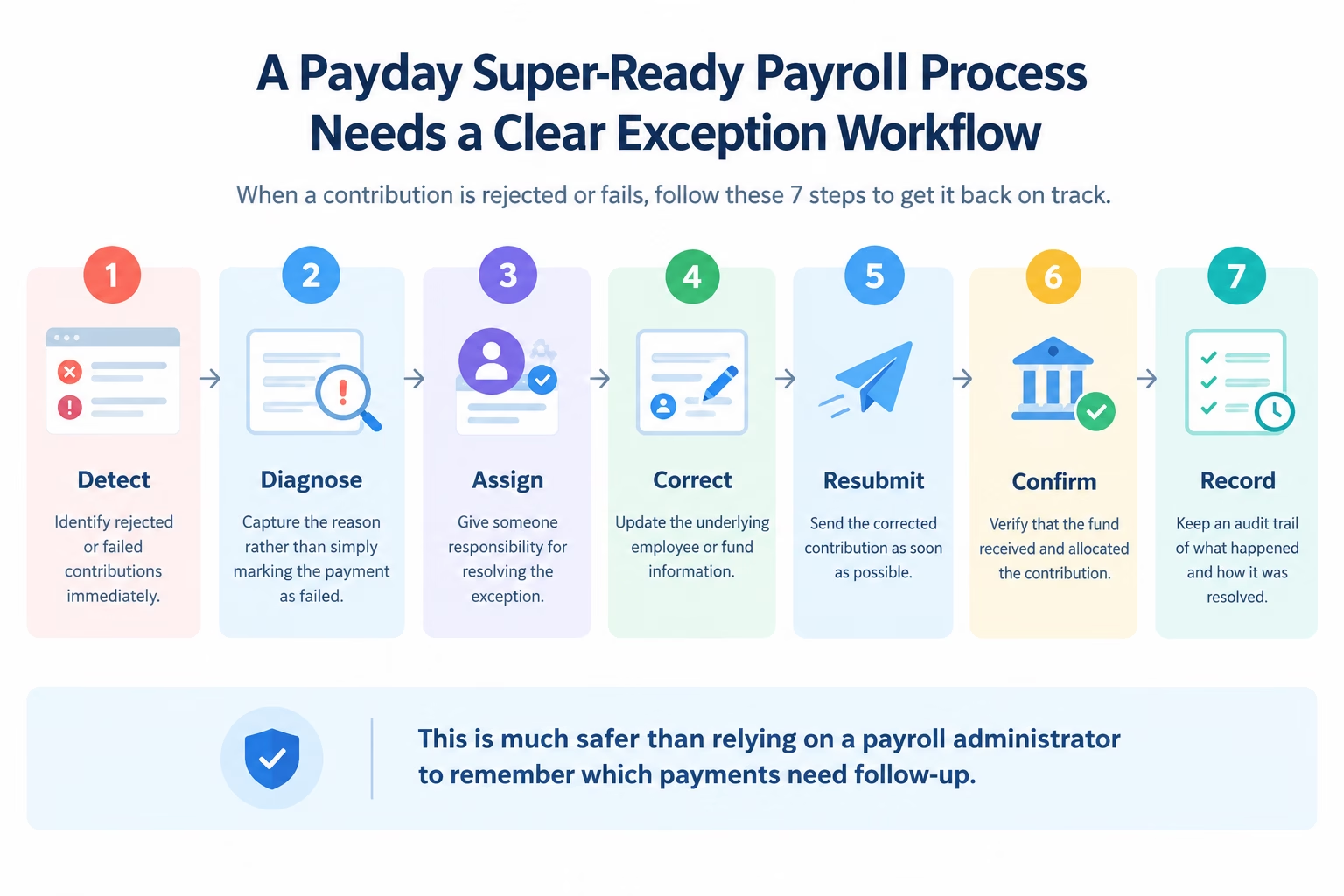
Step 1: Read the rejection reason
Do not simply resend the same payment.
The rejection message should be reviewed to determine what failed.
Step 2: Check the employee’s payroll record
Compare the submitted information with the employee’s records.
Check:
- employee name
- date of birth
- TFN
- fund name
- USI
- member number
- contribution details
Step 3: Confirm the information with the employee
If the payroll record appears correct but the fund rejects the contribution, ask the employee to confirm their current fund details.
Step 4: Contact the fund where necessary
If the employee confirms their details but the fund still cannot process the contribution, the employer may need to contact the fund to establish why.
Step 5: Correct the payroll record
Fix the underlying data rather than manually correcting only the current payment.
Otherwise, the same problem can occur again on the next pay run.
Step 6: Resubmit the contribution
Once the problem has been corrected, resubmit the contribution as quickly as possible.
Step 7: Confirm the outcome
Do not close the exception simply because the payment was resubmitted.
The payroll team should confirm that the contribution was successfully received and allocated.
Example: how a rejected payment can create a payroll bottleneck
Imagine a business with 400 employees.
Its fortnightly payroll produces 400 super contribution records.
Three employees have outdated fund information.
Instead of three isolated corrections, the payroll team now has to:
- identify the three rejected payments
- investigate the errors
- contact employees
- update the records
- resubmit the contributions
- monitor whether they were accepted
- retain evidence of the corrective action
Now multiply that across multiple pay cycles.
The operational problem is not the number of rejected payments alone.
It is the lack of visibility over exceptions.
Rejected payments and the ATO’s first-year compliance approach
The ATO’s first-year compliance approach recognises that employers may encounter operational problems while implementing Payday Super.
Under PCG 2026/1, an employer can fall within the low-risk zone where it attempts to make sufficient on-time contributions, some contributions are not received on time, and the employer resolves the issue as soon as reasonably practicable so that final SG shortfalls are nil.
That does not mean employers can ignore rejected payments.
The opposite is true.
The guideline makes the employer’s response to the problem important.
A business that identifies a rejected payment and quickly corrects it is in a materially different position from a business that leaves an SG shortfall unresolved.
How MVR can reduce rejected payments
Member Verification Requests provide a preventative layer.
An MVR can be used in relevant circumstances to verify that an employee is a member of a fund and that the fund can accept contributions before the first contribution is made. It can also be used as part of corrective action after a rejected contribution.
The practical difference is:
Without verification
Employee details → contribution → rejection → investigation
With verification
Employee details → verification → correction → contribution
The second workflow moves error detection earlier.
Build a rejected-payment workflow
A clear workflow should look something like this:
What should payroll software show?
For employers with large workforces, a Payday Super solution should provide visibility into payment exceptions.
Useful capabilities include:
- contribution status
- rejected payment alerts
- rejection reason
- employee affected
- fund affected
- payment date
- corrective action status
- resubmission status
- confirmation of successful processing
- audit history
The exact features vary between payroll providers, so employers should assess the workflow rather than simply asking whether a system is “Payday Super ready”.
Workstem helps to detect errors early
A rejected contribution is only the beginning of the problem. Payroll teams need to identify what went wrong, correct the underlying information and confirm that the contribution has been successfully processed.
Workstem brings payroll and super into one workflow, with validation before submission and contribution records that let you track paid and pending contributions.
See how Workstem can help you manage Payday Super contributions from calculation to submission and tracking.
Frequently asked questions
Q1: Does a rejected super payment extend the seven-business-day deadline?
A1: No. A rejected payment does not create a new seven-business-day period. The employer should correct and resubmit the contribution as quickly as possible.
Q2: How long does a super fund have to return a rejected contribution?
A2: Under the Payday Super framework, super funds generally have three business days to allocate a contribution or return it where they cannot allocate it.
Q3: Can an MVR help prevent rejected contributions?
A3: Yes. MVR can verify relevant member and fund information before a contribution is made in circumstances where MVR is applicable.
Q4: Are rejected payments automatically an ATO compliance problem?
A4: Not necessarily. The ATO’s first-year PCG recognises employers who make genuine attempts to comply and promptly resolve issues. However, employers should not interpret the low-risk approach as permission to leave contributions unresolved.
Read More:
More Payday Super related articles
Payday Super Australia 2026: Real-Time Superannuation Payment Guide
How Payday Super Affects Your Business
Payday Super Cash Flow Management: Avoiding Business Disruption
What Actually Breaks Payday Super: 7 Operational Failure Points
MVR Explained for Employers: What Happens Before Super Is Sent
Other Superannuation related articles
Superannuation Guarantee 2026: 12% Rate Complete Guide