


Table of content
- What does “low risk” actually mean
- What does the ATO actually look at
- The low-risk strategy is operational
- Example: rejected payment
- Example: incorrect qualifying earnings calculation
- What employers should monitor every pay run
- Does being low risk mean the ATO cannot audit you
- How to stay in the low-risk zone
- Build a Payday Super process that keeps exceptions visible
- Frequently asked questions
- Read More:
Payday Super does not mean every payroll error will automatically trigger ATO enforcement.
But the ATO has made it clear that it will use a risk-based compliance approach during the first year of Payday Super.
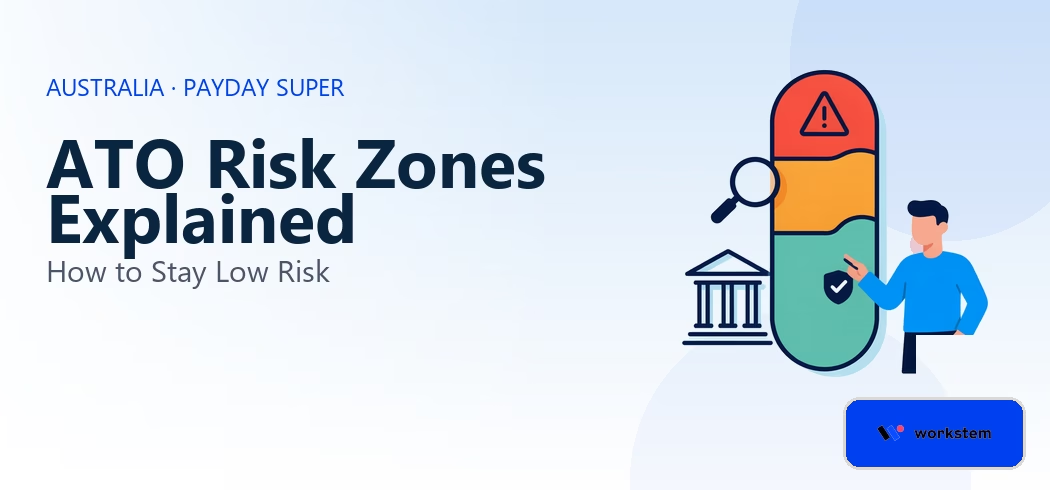
Practical Compliance Guideline PCG 2026/1 sets out three risk zones for the period from 1 July 2026 to 30 June 2027:
- Low risk
- Medium risk
- High risk
The important distinction is not simply whether an employer makes a mistake.
It is how the employer attempts to comply and how quickly any shortfall is resolved.
What are the Payday Super ATO risk zones
The ATO’s PCG 2026/1 provides a framework for prioritising compliance resources during the first year of Payday Super.
The three zones are:
| Risk Zone | Broad position |
| Low | Employer attempts to make sufficient on-time contributions and promptly resolves payment problems so final SG shortfalls are nil |
| Medium | Employer does not meet the low-risk criteria, but final SG shortfalls for all employees are nil within 28 days after the end of the relevant quarter |
| High | One or more individual final SG shortfalls remain greater than nil after that 28-day point |
This framework is about how the ATO allocates compliance resources. It does not change the underlying legal obligations.
What does “low risk” actually mean
This is where employers need to be careful.
The low-risk approach broadly applies where the employer:
- attempts to ensure individual base SG shortfalls are nil for the QE day
- makes sufficient on-time contributions
- experiences an issue where some contributions are not received by the fund on time
- corrects the issue as soon as reasonably practicable
- ultimately has nil individual final SG shortfalls
The ATO states that it will not have cause to apply compliance resources to review employers that fall within the low-risk zone under the guideline.
What can push an employer into medium risk
An employer may fall into the medium-risk zone where it does not satisfy the low-risk criteria but resolves all individual final SG shortfalls by the end of 28 days after the end of the quarter in which the qualifying earnings were paid.
The ATO may apply compliance resources to these cases, although medium-risk cases receive lower priority than high-risk cases.
A simple example is an employer that has moved away from quarterly payment practices but still experiences delays and ultimately resolves the relevant shortfalls within the specified period.
The important point is that medium risk is not the same as compliant-by-design.
What puts an employer into high risk
The high-risk zone is where an employer does not meet the low- or medium-risk criteria.
In particular, the ATO identifies an employer as high risk where one or more individual final SG shortfalls remain greater than nil after 28 days following the end of the quarter in which the qualifying earnings were paid.
This creates a clear operational lesson:
Unresolved shortfalls are the problem.
A payroll team should therefore focus on detecting and resolving exceptions rather than waiting for the next quarterly reconciliation.
Why the 28-day point can be misleading
Employers should not interpret the 28-day period as an alternative payment deadline.
Payday Super generally requires contributions to be received by the fund within seven business days of payday.
The 28-day reference in PCG 2026/1 is part of the ATO’s risk-based compliance approach.
It does not replace the underlying Payday Super payment obligation. This distinction is critical.
Payment obligation
Generally:
Payday → super received within 7 business days
First-year compliance risk framework
For the ATO’s risk assessment:
QE day → relevant quarter ends → 28-day assessment point
These are two different concepts.
What does the ATO actually look at
The ATO has long used data matching and analytical models to identify employers with potential super guarantee compliance issues.
Its compliance approach can compare information from sources including payroll and superannuation data.
Payday Super increases the importance of data consistency because super obligations are being reported and paid more closely around each pay event.
Questions employers should ask
- Was the correct amount calculated?
- Was it based on the correct qualifying earnings?
- Was it paid to the correct fund?
- Was it received on time?
- Was it allocated?
- Was a rejected payment resolved?
- Does STP reporting align with the contribution data?
- Can we demonstrate what happened?
The low-risk strategy is operational
The best way to stay in the low-risk zone is not to create a compliance document after the fact.
It is to build a payroll process that naturally produces the required behaviour.
That means:
1. Calculate correctly
Use the correct qualifying earnings rules.
2. Pay promptly
Do not wait until the end of a payment cycle to start processing super.
3. Monitor exceptions
Identify rejected or failed contributions quickly.
4. Correct errors
Fix the underlying problem instead of simply retrying the payment.
5. Confirm allocation
Know whether the contribution reached the employee’s fund.
6. Maintain evidence
Keep an audit trail showing what was calculated, submitted, rejected, corrected and ultimately paid.
Example: rejected payment
Consider an employer that makes a sufficient super contribution on payday.
The payment is rejected because the employee’s fund information does not match.
The employer:
- identifies the rejection
- contacts the employee
- corrects the fund information
- resubmits the contribution
- confirms that the fund receives it
- records the resolution
Under PCG 2026/1, this type of behaviour can fall within the low-risk approach where the relevant criteria are satisfied and final SG shortfalls are nil.
The lesson is not that rejected payments are harmless.
It is that prompt remediation matters.
Example: incorrect qualifying earnings calculation
Now consider a different employer. It calculates SG incorrectly because a payment that should have been included in qualifying earnings was excluded. The employer therefore underpays SG.
If the resulting shortfall remains unresolved, this can move the employer into a higher-risk category under the ATO’s framework. PCG 2026/1 specifically includes incorrect qualifying earnings calculations among its high-risk examples.
This is why Payday Super compliance starts upstream.
The problem may begin with:
pay item classification → QE calculation → SG calculation → payment → STP reporting
By the time the payroll team sees a super shortfall, the original error may have occurred much earlier.
What employers should monitor every pay run
A Payday Super dashboard or payroll control report should ideally answer:
- How much super was calculated?
- How much was submitted?
- How much was received?
- Which payments failed?
- Why did they fail?
- Which employees are affected?
- What has been corrected?
- Are there any unresolved shortfalls?
The objective is to identify problems while they are still small and fixable.
Does being low risk mean the ATO cannot audit you
Not necessarily. The PCG 2026/1 explains how the ATO will allocate compliance resources for the first year of Payday Super. It does not eliminate the employer’s underlying obligations or prevent other compliance action.
The guideline also applies specifically to qualifying earnings days occurring from 1 July 2026 to 30 June 2027. The fact that an employer is low risk during this period does not automatically determine its risk status after 1 July 2027.
So employers should treat the first-year framework as a transition approach, not a permanent safe harbour.
How to stay in the low-risk zone
Use this as a practical checklist:
- Calculate SG using the correct qualifying earnings rules
- Make sufficient contributions on time
- Monitor contribution status
- Identify rejected payments quickly
- Correct rejected contributions as soon as reasonably practicable
- Track unresolved SG shortfalls
- Reconcile payroll and super data
- Ensure STP reporting is accurate
- Keep evidence of corrective action
- Review recurring errors instead of treating them as isolated incidents
Build a Payday Super process that keeps exceptions visible
Staying on top of Payday Super is not just about calculating the right amount. Employers also need to know what was submitted, what was paid, which contributions are pending and whether any issues still need attention.
Workstem automates QE-based SG calculations, processes super with payroll, generates SuperStream files and keeps contribution records for ongoing reporting and compliance visibility.
Build a clearer Payday Super workflow with payroll, super and contribution tracking in one system.
Frequently asked questions
Q1: What are the three Payday Super ATO risk zones?
A1: The ATO’s PCG 2026/1 establishes low-, medium- and high-risk zones for the first year of Payday Super.
Q2: What is the low-risk zone for Payday Super?
A2: Broadly, employers are in the low-risk zone where they attempt to make sufficient on-time contributions, encounter payment issues, promptly resolve those issues and ultimately have nil individual final SG shortfalls.
Q3: What is the medium-risk zone?
A3: An employer can fall into the medium-risk zone where it does not satisfy the low-risk criteria but all individual final SG shortfalls are nil by the end of 28 days after the end of the relevant quarter.
Q4: What is the high-risk zone?
A4: An employer is in the high-risk zone where it does not satisfy the low- or medium-risk criteria. This includes cases where an individual final SG shortfall remains greater than nil after 28 days following the end of the relevant quarter.
Q5: Does the 28-day period replace the seven-business-day Payday Super deadline?
A5: No. The seven-business-day requirement is the general payment timing rule. The 28-day period is part of the ATO’s first-year compliance risk framework.
Q6: Does low risk mean an employer can ignore late super payments?
A6: No. Employers still need to meet their legal obligations. The low-risk approach concerns how the ATO prioritises compliance resources during the first year; it is not permission to deliberately pay super late.
Read More:
More Payday Super related articles
Payday Super Australia 2026: Real-Time Superannuation Payment Guide
How Payday Super Affects Your Business
Payday Super Cash Flow Management: Avoiding Business Disruption
Payday Super Rejected Payments: What Employers Should Do
Payday Super Maximum Contribution Base: Annual MCB Explained
MVR Explained for Employers: What Happens Before Super Is Sent
Superannuation Guides
Superannuation Guarantee 2026: 12% Rate Complete Guide