


Choosing payroll software in Australia is not simply a question of which platform has the longest feature list.
The more important question is how your payroll actually works.
For businesses with modern awards, variable shifts, multiple locations or hourly employees, the connection between rostering, attendance, award rules and payroll can matter as much as the payroll engine itself.
Employment Hero and Workstem both cover payroll, HR and workforce management, but their product emphasis is different.
This comparison looks at the current publicly documented capabilities of both platforms in 2026 and where each may fit best.
Employment Hero vs Workstem: Which is better in 2026?
Employment Hero is a broader HR platform with a large ecosystem covering areas such as recruitment, performance, learning, employee engagement and payroll.
Workstem is built around a more tightly connected HR, workforce management and payroll workflow, with particular emphasis on award interpretation, rostering, attendance and payroll calculation.
The better fit depends on whether your priority is broader HR functionality or a tightly connected workforce-to-payroll workflow.
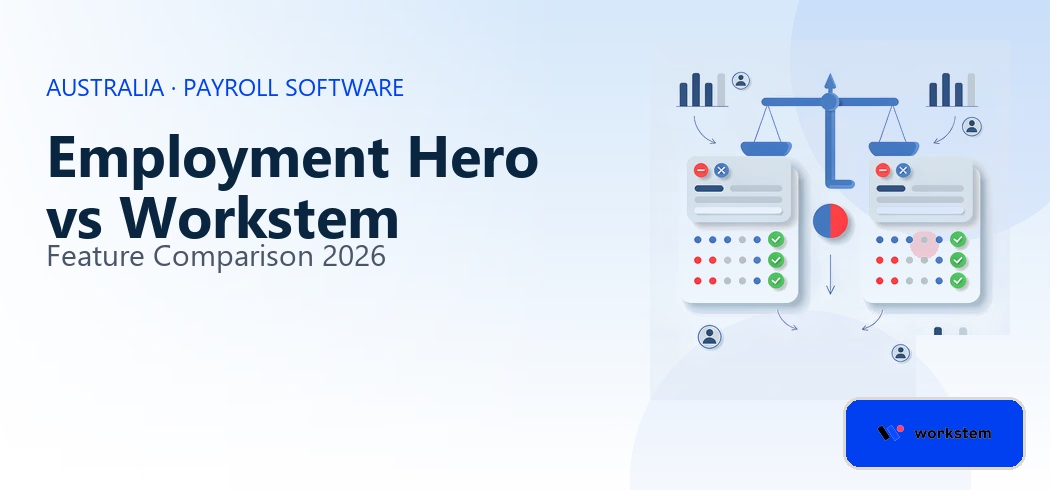
Employment Hero vs Workstem comparison
| Feature | Employment Hero | Workstem |
| Payroll | Yes | Yes |
| STP Phase 2 | Yes | Yes |
| Superannuation | Yes | Yes |
| Award interpretation | Yes | Yes |
| Overtime calculations | Yes | Yes |
| Penalty rates | Yes | Yes |
| Rostering | Yes | Yes |
| Timesheets | Yes | Yes |
| Attendance / clock-in | Yes | Yes |
| Labour cost forecasting | Yes | Yes |
| Shift swapping | Yes | Yes |
| Leave management | Yes | Yes |
| Expenses | Yes | Yes |
| Recruitment | Yes | Available within broader HR capabilities |
| Performance management | Yes | More workforce/payroll focused |
| Learning | Yes | More workforce/payroll focused |
| HR advisory services | Yes | Not the same service model |
| Award updates | Yes | Fair Work API-based updates |
| GPS / geofencing | Yes | Yes |
| Multiple clock-in methods | Mobile/kiosk and related time-clock options | GPS, QR, Bluetooth and facial recognition |
| API / integrations | Broad integration ecosystem | API and accounting/integration support |
| Workforce-to-payroll workflow | Integrated | Integrated |
Employment Hero’s current public product and pricing pages show payroll, HR, recruitment, expenses, performance management, learning and rostering/time and attendance capabilities, with some workforce features available as add-ons depending on plan.
Workstem publicly positions its Australian platform around onboarding, rostering, attendance, leave, payroll, award interpretation, STP2 and superannuation, with the modules operating on one platform.
1. Payroll and STP Phase 2
Both platforms cover the core requirements expected from Australian payroll software.
Employment Hero describes its payroll platform as ATO-recognised and supporting STP Phase 2, SuperStream, Payday Super, PAYG, modern awards and penalty rate changes.
Workstem similarly supports STP Phase 2, PAYG, superannuation, bank ABA files and payroll calculations for base rates, overtime, allowances, loadings and leave.
For a conventional salary-based workforce, this category alone is unlikely to decide the purchase.
The bigger question is how payroll gets its inputs.
2. Award interpretation
This is one of the most important areas for award-heavy employers.
Employment Hero’s award interpretation engine supports rules for overtime, higher duties, allowances and time off in lieu. Its pay categories are linked so related penalties can update when base rates change. It also provides a rule tester to interpret timesheets and calculate costs before the final pay run.
Workstem also focuses heavily on award interpretation. Its platform supports 122+ modern awards and 34 EAs, with award updates through the Fair Work API. It can calculate ordinary hours, overtime, penalties and allowances and perform compliance checks on pay data.
For employers comparing the two, the useful question is not simply:
“Does it support awards?”
Both do.
Ask instead:
“How easily can my award rules be connected to the actual hours my employees worked?”
That becomes important for hospitality, retail, healthcare, construction and other shift-heavy industries.
3. Rostering and workforce planning
Employment Hero’s rostering platform supports budget-based scheduling, shift costing, employee availability, shift swaps and comparison of rosters with actual timesheets.
Workstem also provides roster templates, bulk scheduling, employee availability, open shifts, multi-site scheduling and labour-cost forecasting. Its rostering module connects directly with time and attendance and payroll.
The distinction is less about whether a roster can be created and more about how the roster fits into the rest of the workforce workflow.
Workstem is particularly explicit about the chain:
Roster → Attendance → Award Interpretation → Payroll
That model is useful for businesses where a change on the roster can have a direct impact on the final pay calculation.
4. Time and attendance
Employment Hero supports time clocks, geofencing, timesheets and attendance tracking, with different functionality depending on plan.
Workstem supports GPS, QR, Bluetooth and facial-recognition clock-in options, together with attendance rules and direct payroll synchronisation.
For a workforce operating across multiple sites, the key consideration is whether attendance data is reliably captured and then converted into payroll inputs without repeated manual handling.
5. Labour cost visibility
Both platforms now put more emphasis on workforce cost visibility.
Employment Hero can calculate shift costs based on employee settings, awards and rule sets and compare rosters against timesheets.
Workstem provides projected labour-cost visibility before rosters are published and can compare rostered and actual attendance data.
This is increasingly important for hospitality and multi-site employers, because payroll compliance and labour-cost management are no longer separate problems.
A roster that looks operationally correct can still create an unexpected labour cost when overtime or penalty conditions are applied.
6. Broader HR functionality
This is where Employment Hero has a clear breadth advantage.
Its current platform covers HR, recruitment, payroll, performance management, learning, expenses, employee engagement and workforce management.
Workstem also covers the core employee lifecycle, including onboarding, records, leave, expenses, rostering, attendance and payroll, but its Australian positioning is more heavily centred on workforce operations and payroll compliance.
For a company looking to consolidate a large HR technology stack across recruitment, performance and learning, Employment Hero’s broader ecosystem may be more attractive.
For a company primarily trying to connect frontline workforce operations to payroll, Workstem may be the more focused fit.
Which should you choose?
Choose Employment Hero when:
- You want a broad HR ecosystem alongside payroll.
- Your organisation needs recruitment, performance, learning and HR engagement capabilities.
- You prefer a modular platform where workforce functions can be added to the broader HR environment.
Choose Workstem when:
- Your payroll risk is strongly connected to rosters and attendance.
- You have a large hourly or shift-based workforce.
- You operate under multiple modern awards or EBAs.
- You want award interpretation, attendance, rostering and payroll connected within one workflow.
- You need multiple clock-in methods across sites or different workforce environments.
What should you compare before signing?
Do not compare software from screenshots alone.Run both platforms through the same real scenario.
For example:
- Employee: Level 1 hospitality employee
- Roster: Friday evening + Saturday + Sunday
- Actual: 30 minutes overtime
- Break: missed
- Location: second site
- Payroll: weekly
- Award: MA000009
Then ask each vendor to show:
- how the employee is classified
- how the roster is created
- how attendance is captured
- how the missed break is handled
- which penalty rates are triggered
- how overtime is calculated
- how the approved timesheet reaches payroll
- how the final calculation can be audited
That exercise tells you much more than a 100-row feature comparison.
Employment Hero vs Workstem: final verdict
Employment Hero is a strong choice for businesses looking for a broad HR and employee-management ecosystem.
Workstem is positioned more strongly around connecting workforce operations, award interpretation and payroll in a single process.
For businesses where the hardest payroll problem starts before the pay run — in rosters, attendance, classifications and award rules — that distinction is worth testing carefully.
The right question is not which system has more features.
It is: Which system fits the way your people actually work?
Employment Hero vs Workstem FAQ
Q1: Is Workstem better than Employment Hero?
A1: Neither platform is universally better. Employment Hero offers a broader HR ecosystem, while Workstem places stronger emphasis on connecting rostering, attendance, award interpretation and payroll. The better option depends on the employer’s workforce structure and priorities.
Q2: What is the difference between Employment Hero and Workstem?
A2: Both provide HR and payroll capabilities, but their product emphasis differs. Employment Hero covers a broad range of HR functions, while Workstem focuses heavily on workforce management, award interpretation and the connection between employee hours and payroll.
Q3: Which is better for award-heavy businesses in Australia?
A3: Both platforms support award-based payroll, so the important comparison is how each handles the full workflow. Businesses with large numbers of hourly or shift-based employees should test classification, rosters, attendance, overtime, penalty rates and payroll calculations using their own real scenarios.
Q4: Does Workstem support Australian awards?
A4: Yes. Workstem’s Australian award interpretation platform supports 122+ modern awards and 34 enterprise agreements, with award updates through the Fair Work API. Employers still need to verify award coverage and employee classifications.
Q5: Does Employment Hero support award interpretation?
A5: Yes. Employment Hero provides award interpretation functionality covering areas such as overtime, penalties and allowances. The exact functionality available depends on the relevant product and plan.
Q6: Which platform is better for hospitality businesses?
A6: For hospitality employers, compare both platforms using a real hospitality scenario rather than a feature checklist. Test a combination of weekday, Saturday, Sunday, public holiday, overtime, breaks, casual employment and award classification conditions.
Q7: Can both platforms handle rostering and attendance?
A7: Yes. Both platforms provide workforce scheduling and attendance-related functionality. The more important question is how easily actual attendance data flows into award interpretation and payroll.
Q8: What should I test before choosing payroll software?
A8: Use an actual employee and shift pattern from your business. Test onboarding, classification, rostering, clock-in, breaks, timesheet approval, overtime, penalty rates and final payroll output. A live scenario will reveal workflow differences much faster than comparing feature lists.