



Not sure what you should be paid for working on a Saturday, Sunday, or public holiday? You’re not alone. Millions of Australian workers are covered by penalty rates yet underpayment remains one of the most common workplace issues reported to the Fair Work Ombudsman.
This guide explains what penalty rates are, who sets them, how to calculate them, and where to use a reliable weekend rates calculator.
What Are Penalty Rates in Australia?
Penalty rates are legally mandated higher pay rates that apply when employees work outside standard business hours. This includes weekends, public holidays, early mornings, and late evenings.
They are set by Modern Awards under the Fair Work Act 2009 not by employers decision. Over 120 Modern Awards exist in Australia, each with its own penalty rate structure.
Who sets them? The Fair Work Commission (FWC) — the national workplace relations tribunal reviews and updates award rates annually, with changes typically taking effect from 1 July each year.
Why Do Penalty Rates Exist?
Penalty rates exist to compensate employees for the personal and social cost of working when most Australians have time off. The principle is simple: if your employer requires you to work on a Sunday or a public holiday, you should be paid more.
In August 2025, the Australian Government strengthened these protections through the Fair Work Amendment (Protecting Penalty and Overtime Rates) Act 2025, which limits the FWC’s ability to reduce penalty or overtime rates in awards. This change protects the wages of approximately 2.6 million Australian workers.
What Are the Standard Weekend Rates? (2025–26)
Penalty rate percentages are calculated on top of your base hourly rate. Here is a general guide across common awards:
| Day | Full Time/ Part Time | Casual |
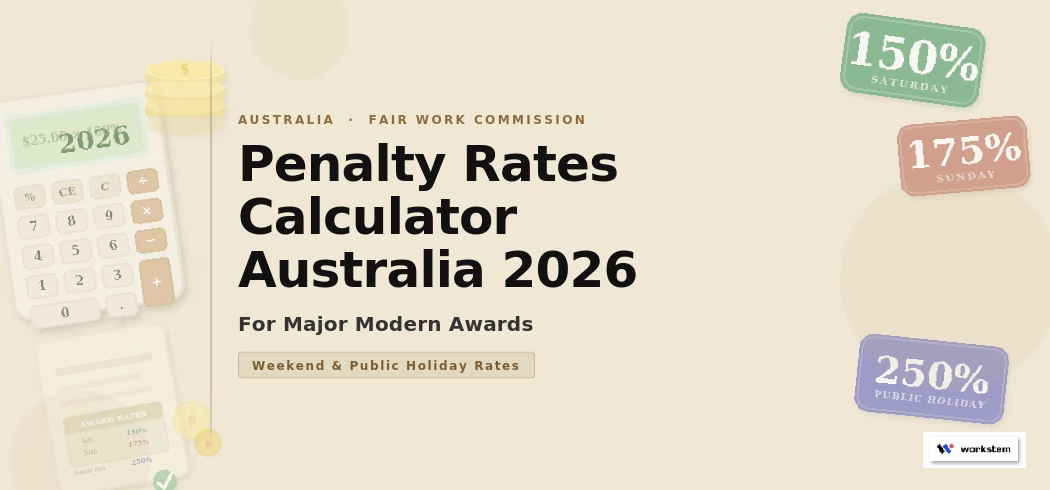
| Saturday | 150% | 175% |
| Sunday | 150% | 175% |
| Public Holiday | 225-250% | 250% |
Example: If your base rate is $25.05/hr (the 2025–26 minimum wage) and you work on a public holiday at 250%, you earn $62.63/hr for that shift.
Note: Rates vary significantly by award. For example, The Clerks — Private Sector Award applies a 200% Sunday rate, while retail and hospitality settled at 150% following a FWC decision. Always be sure to check the specific award.
How to Use a Penalty Rates Calculator
A weekend rates calculator helps you quickly determine total shift earnings without navigating complex award documents. To get an accurate result, you need to know:
- Your award — e.g. General Retail Industry Award, Hospitality Industry (General) Award
- Your employment type — full-time, part-time, or casual
- Your base hourly rate
- The day and hours worked
The Fair Work Ombudsman’s Pay and Conditions Tool (PACT) is the most authoritative free calculator available.
When Do the 2026 Rates Take Effect?
The FWC Annual Wage Review decision is expected in early June 2026, with updated rates effective from the first full pay period on or after 1 July 2026. Award penalty rates are adjusted by the same percentage as the base rate increase each year.
Key Takeaways
- Penalty rates are set by the Fair Work Commission and enforced by the Fair Work Ombudsman.
- Weekend and public holiday rates range from 125% to 250% depending on your award and employment type.
- Underpayment of penalty rates is a serious issue as wage theft is now a criminal offence under Commonwealth law.
- Use the official PACT tool or a trusted weekend rates calculator to verify your entitlements.
*Source: Fair Work Ombudsman | Fair Work Amendment (Protecting Penalty and Overtime Rates) Act 2025
FAQs About Penalty Rates Australia 2026
Q1: What is the Sunday penalty rate in Australia for retail workers?
A1: Under the General Retail Industry Award 2020, full-time and part-time employees working on a Sunday are paid 150% of their base rate. Casual employees receive 175%, as their rate incorporates the 25% casual loading. These rates apply across all states and territories — Modern Award penalty rates are set federally by the Fair Work Commission and are not state-specific.
Q2: Do penalty rates apply to salaried employees?
A2: Yes, but only if your salary doesn’t already compensate for all award entitlements, including penalty rates. If employees work regular weekends or public holidays and the annualised salary doesn’t cover those additional rates under an award, employees may be entitled to top-up payments. Employers must be able to demonstrate, using records, that the salary genuinely compensates for all award conditions including penalty periods.
Q3: Can employer refuse to pay penalty rates in Australia?
A3: No. If penalty rates are specified in the Modern Award or enterprise agreement, they are a legal minimum entitlement and cannot be contracted out of or waived without proper authorisation. Since August 2025, the Fair Work Amendment (Protecting Penalty and Overtime Rates) Act 2025 has further restricted the Fair Work Commission’s ability to reduce award penalty rates. Underpayment of penalty rates is a breach of the Fair Work Act 2009 and may constitute wage theft under Commonwealth law.
Q4: How do I find which penalty rates apply?
A4: Start by identifying your Modern Award using the Fair Work Ombudsman’s Award Finder at fairwork.gov.au. Common awards include the General Retail Industry Award, the Hospitality Industry (General) Award, and the Clerks — Private Sector Award. Once you know your award, use the official Pay and Conditions Tool (PACT) to look up the exact penalty rate for your employment type, day, and shift hours.
Q5: Are penalty rates the same as overtime rates?
A5: No, they are different, though both can apply in the same shift. Penalty rates apply based on when you work (weekends, public holidays, evenings). Overtime rates apply based on how many hours you work beyond your ordinary hours (typically after 38 hours per week or beyond your rostered shift). In some scenarios — for example, working overtime on a Sunday — both can apply simultaneously, though the specific interaction depends on your award.
Read More
HR Tools & Calculators
Australian Annual Leave Calculator
HR Terms & Definitions (Australia)
What are sunday penalty rates in australia?
Public Holidays & Award Related
New Year’s Day 2026 Penalty Rates: State-by-State Guide
Retail Worker Rights: Award Rates and Penalty Rates Explained
Leave Management & HR Software
Leave Management Software vs. Excel: Which is More Effective?
Discover the Benefits of Leave Management Software: Say Goodbye to Excel!
Why You Need to Automate Your Leave Management with HR Software