



Table of content
- What is construction workforce planning?
- The hidden cost of overstaffing
- Understaffing can be just as expensive
- Construction workforce planning needs demand visibility
- Shift planning turn workforce requirements into something managers can actually schedule
- Workforce planning should account for employee availability
- Labour utilisation is more useful than headcount alone
- Moving labour between sites should be a controlled process
- Workforce planning should consider labour cost before the roster is published
- Connected workforce planning with actual project hours
- Example: planned vs actual project labour
- Construction workforce planning needs both short-term and long-term views
- Read more
A construction project can have enough workers overall and still be short of labour. The problem is usually not the total headcount. It is where the workers are, when they are available, what skills they have and which project needs them next.
A project may need 15 workers tomorrow but only have 12 scheduled.Another site may have 18 workers scheduled when it only requires 14. The business technically has enough employees. The workforce is simply allocated poorly.
This is why construction workforce planning is more than hiring. It is the process of matching future project demand with available labour while controlling cost.
For Australian construction businesses operating across multiple sites, effective workforce planning needs to connect:
Project demand → Required headcount → Employee availability → Roster → Attendance → Actual labour utilisation
Learn how to adopt a software that provides a practical structure for doing this, including planned staffing numbers, project/job allocation and tracking of expected versus actual attendance hours.
What is construction workforce planning?
Construction workforce planning is the process of determining:
- how many workers a project needs
- which roles or skills are required
- when workers are required
- where they need to work
- which employees are available
- how much the planned labour will cost
- whether actual labour usage matches the plan
It is different from simply creating a roster.
A roster answers:
“Who is working tomorrow?”
Workforce planning asks:
“What workforce will we need across our projects, and how do we allocate it efficiently?”
That distinction becomes increasingly important as a construction company manages multiple active projects.
The hidden cost of overstaffing
Overstaffing is easy to overlook because the site appears productive.
But every unnecessary labour hour has a cost.
Suppose a site needs:
12 workers × 8 hours = 96 labour hours
but schedules:
15 workers × 8 hours = 120 labour hours
The difference is:
24 labour hours
If the average labour cost is $50 per hour:
24 × $50 = $1,200
That is $1,200 of additional daily labour cost.
One day may not matter much but imagine it being repeated over several weeks.
Example
| Planned | Actual | Difference | |
| Workers | 12 | 15 | +3 |
| Hours | 96 | 120 | +24 |
| Labour cost @ $50/hour | $4,800 | $6,000 | +$1,200 |
Payroll is simply paying the hours that were worked. The workforce planning problem occurred earlier: Why were three additional workers scheduled?
Understaffing can be just as expensive
The opposite problem is under-resourcing. Suppose a project requires 20 workers but only 16 are available. The four-worker gap may result in:
- delayed work
- overtime for existing employees
- contractor costs
- reduced productivity
- missed milestones
- workers being transferred from another site
- supervisors spending time finding replacements
The apparent labour saving can therefore create a larger project cost elsewhere. This creates a fundamental workforce planning principle:
The cheapest roster is not necessarily the lowest-cost workforce plan.
The objective is to have the right level of labour for the work that actually needs to be done.
Construction workforce planning needs demand visibility
Project managers typically know what work needs to happen. The workforce challenge is translating that requirement into people.
For example:
| Project | Work requirement | Required staff | Scheduled | Gap |
| Project A | Structural works | 20 | 20 | 0 |
| Project B | Fit-out | 15 | 12 | -3 |
| Project C | Civil works | 10 | 13 | +3 |
| Project D | Electrical | 8 | 8 | 0 |
This tells management something a simple employee list cannot:
Project B has a labour shortage while Project C may have excess capacity.
That opens up a workforce allocation decision. Can suitable workers be moved from Project C to Project B?
If so, the company may solve the shortage without hiring additional labour.
Shift planning turn workforce requirements into something managers can actually schedule
This is where Workstem’s Open Shift functionality becomes particularly relevant.
Open Shift allows managers to preset future shifts and specify the required number of employees. The system then tracks how many employees have been scheduled against the planned requirement.
For example:
Project: Riverside Development
Location: Site A
Date: Monday
Shift: 7:00 am–3:30 pm
Required workers: 15
The scheduling process can then work towards filling those 15 positions.
Planned versus filled
| Open Shift | Required | Scheduled | Remaining |
| Site A – Day Shift | 15 | 15 | 0 |
| Site B – Day Shift | 12 | 10 | 2 |
| Site C – Night Shift | 8 | 8 | 0 |
This gives managers an immediate view of staffing gaps.
Workforce planning should account for employee availability
Knowing how many people are required is only half the problem.
Managers also need to know:
Who can actually work?
Construction businesses may need to consider:
- leave
- days off
- existing shifts
- location
- availability
- qualifications
- project requirements
- overlapping assignments
Workstem’s Australian rostering platform provides real-time staff availability and day-off information through its mobile app, while employees can manage availability and view their rosters.
That gives managers a more realistic labour pool to schedule from.
Labour utilisation is more useful than headcount alone
Headcount is a crude workforce metric.
A company with 100 employees does not necessarily have 100 productive workers available for every project.
The question employers should ask is:
How much of the available workforce is being effectively deployed?
For example:
| Metric | Result |
| Total employee | 100 |
| Employees available | 82 |
| Employees scheduled | 76 |
| Required labour | 78 |
| Staffing gap | 2 |
| Unallocated available employees | 6 |
This immediately gives management more useful information.
There are six available employees who are not currently allocated while another project has a two-person shortage.
That is a workforce allocation opportunity.
Moving labour between sites should be a controlled process
Construction companies frequently move employees between projects.
This can solve short-term labour shortages.
But unmanaged movement creates another problem.
An employee may be:
Originally scheduled → Site A
then moved to:
Site B
while the original roster remains unchanged.
Now the business can have:
- incorrect project allocation
- incorrect attendance location
- inaccurate project costing
- duplicate scheduling
- payroll reconciliation problems
Workstem supports multiple locations and scheduling changes through its rostering platform, including mobile scheduling for supervisors.
Workforce planning should consider labour cost before the roster is published
A workforce plan without cost visibility is incomplete.
Suppose two staffing options exist:
Option A
10 workers × 8 hours × $50
$4,000
Option B
12 workers × 8 hours × $50
$4,800
The second option costs $800 more per day. That may be justified. Perhaps the additional workers prevent a major project delay. But management should know the financial impact before publishing the roster.
Workstem’s Australian rostering platform provides projected labour-cost forecasting by roster, location or project before publishing.
This gives managers the ability to adjust staffing while the cost is still controllable.
Connected workforce planning with actual project hours
Planning tells you what should happen.
Actual attendance tells you what happened.
Workstem’s Project/Job Pro supports expected and actual attendance hours against project/job records. It can also generate category-level reports and accumulate project/job hours after payroll calculation for eligible scheduled shifts.
That creates an important feedback loop:
Planned hours
↓
Scheduled hours
↓
Actual attendance
↓
Project hours
↓
Variance
The variance is where management learns.
Example: planned vs actual project labour
Imagine a project is planned for:
2,000 labour hours
After three weeks:
Scheduled: 1,500 hours
Actual: 1,650 hours
The project is already:
150 hours above plan
At $50 per labour hour, that represents:
$7,500 of additional labour
The question now becomes:
Why?
Possible explanations include:
- project delay
- overtime
- understaffing earlier in the project
- inefficient allocation
- unexpected work
- incorrect scheduling
- attendance anomalies
Without project-level hour tracking, management may only see the final payroll number.
With project-level tracking, management can investigate the variance.
Construction workforce planning needs both short-term and long-term views
There are two different planning horizons.
Short-term workforce planning
Usually focuses on:
- tomorrow
- this week
- next week
- immediate project requirements
- absences
- shift gaps
- urgent labour movement
Longer-term workforce planning
Focuses on:
- upcoming project stages
- future labour demand
- recruitment
- skills shortages
- project overlaps
- expected workforce capacity
- labour budgets
A scheduling platform cannot replace project management or workforce forecasting.
But it can provide the operational data required to make those decisions.
What is the solution for construction workforce planning?
Workstem’s tools can be structured into a practical workforce planning workflow.
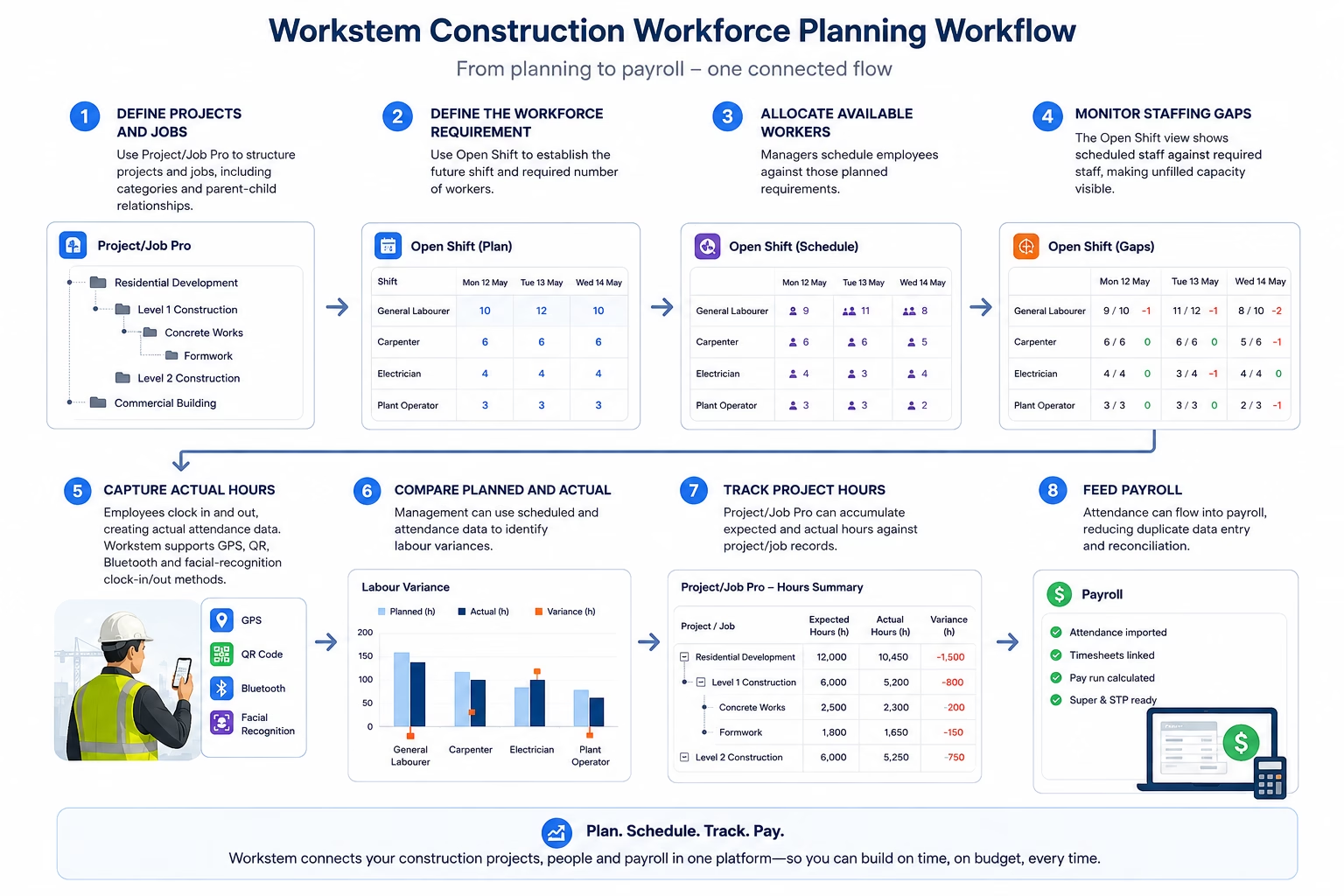
A construction workforce planning dashboard should answer five questions
| Question | Example |
| What work is coming? | Fit-out begins next Monday |
| How many workers are required? | 25 |
| How many are scheduled? | 22 |
| How many actually worked? | 24 |
| What did the labour cost? | $9,600 |
What is a good construction workforce planning software?
When evaluating workforce management software, ask:
| Capability | Why it matters |
| Future staffing requirements | Plan before the shift occurs |
| Open shifts | Define required headcount |
| Employee availability | Know who can actually work |
| Multi-site scheduling | Allocate people across projects |
| Project/job allocation | Connect labour to projects |
| Cost forecasting | Understand planned labour spend |
| Actual attendance | Measure what really happened |
| Planned vs actual hours | Identify labour variance |
| Mobile scheduling | Let site managers manage changes |
| Payroll integration | Turn attendance into payroll |
| Project-hour reporting | Understand labour utilisation |
Why are spreadsheets outdated for workforce planning?
A spreadsheet can show:
Employee → Monday → Site A
But workforce planning needs more dimensions:
Employee + Availability + Skill + Location + Project + Shift + Required Headcount + Cost + Actual Hours
As the number of variables increases, manual planning becomes harder to maintain. The problem is that the spreadsheet does not automatically maintain the relationship between those variables when something changes.
FAQs about Construction
Q1: What is workforce planning in construction?
A1: Construction workforce planning is the process of determining how many workers, which roles and what working hours are required across projects, then matching those requirements with available employees.
It connects project demand with workforce availability, scheduling, attendance and labour cost.
Q2: How can construction companies prevent labour shortages?
A2: Start by defining required headcount for each project and shift, then compare that requirement with employee availability and scheduled workers.
Workstem’s Open Shift functionality allows managers to define the number of employees required for future shifts and track how many positions have been filled.
Q3: How can construction companies reduce overstaffing?
A3: Compare required headcount with scheduled headcount before publishing the roster.
If one project is overstaffed while another has a shortage, managers can investigate whether suitable workers can be reallocated.
Workstem provides projected labour-cost visibility by roster, location or project before publishing, helping managers identify staffing decisions that may affect labour budgets.
Q4: What is labour utilisation in construction?
A4: Labour utilisation measures how effectively a company’s available workforce is being deployed against actual project requirements.
A company can have a large workforce but poor utilisation if employees are unavailable, unallocated, overstaffed on some projects or unavailable where demand exists.
Q5: How can construction businesses compare planned and actual labour hours?
A5: The business needs to connect scheduling with actual attendance and project/job records.
Workstem’s Project/Job Pro supports expected and actual attendance hours for project/job items, allowing businesses to track accumulated project hours and review category-level reports.
6. Can workforce planning software help control construction labour costs?
Yes, provided the software connects staffing requirements with labour rates, scheduled hours and actual attendance.
Workstem’s rostering platform provides projected labour-cost forecasting before rosters are published and project-based rate controls, while attendance and payroll provide the actual labour data after work is performed.
To Wrap Up
Construction businesses do not necessarily have a workforce shortage simply because one project is short of workers.
They may have an allocation problem. One site has too many workers. Another has too few.
One project is accumulating overtime. Another has unused capacity.
One team is approaching a critical project stage. Another is winding down.
The companies that manage this effectively do not rely on headcount alone.
They connect:
Project demand → Required workforce → Employee availability → Scheduling → Attendance → Labour cost
Workstem provides the operational tools to support that workflow through Open Shift planning, project/job management, multi-site rostering, attendance tracking, labour-cost forecasting and payroll integration.
The goal is not to have the most workers.
It is to have the right workers, in the right place, at the right time, at the right cost.
Talk to our team and see how we can help your construction business manage labour more efficiently!
Read more
Construction Payroll & Insights
Best Construction Payroll Software
How to Avoid Fair Work Penalties for Unpaid Wages in Construction
Payroll compliance in construction: Cases from Fair Work learned
Other award related articles
Building and Construction Award
Building & Construction Award (MA000020) Pay Rates 2026/27
Building & Construction Award [MA000020] 2025: Pay Rates & Rights