


Table of content
- Are Christmas Day and Boxing Day public holidays in Australia?
- What are the Christmas Day and Boxing Day pay rates?
- How much should you pay? Christmas and Boxing Day pay examples
- What if an employee does not work on Christmas Day or Boxing Day?
- Does Boxing Day attract an additional Saturday penalty rate?
- What happens when public holiday hours are also overtime?
- Can employees refuse to work on Christmas Day or Boxing Day?
- 6 things hospitality and retail employers should check before the holiday pay run
- Manage Christmas and Boxing Day payroll with Workstem
- Frequently asked questions
- Read more
Christmas and Boxing Day can be some of the busiest trading days of the year for Australian retailers, restaurants, cafés and hospitality venues. For employers, that means more than managing customer demand and staff availability. It also means getting public holiday pay right.
Under several major Australian modern awards, employees who work ordinary hours on Christmas Day or Boxing Day receive 225% of their minimum hourly rate if they are full-time or part-time employees, and 250% if they are casual employees. However, these percentages are not universal. The correct rate depends on the employee’s applicable award or enterprise agreement, classification and whether the hours are ordinary hours or overtime.
This guide explains the Christmas Day and Boxing Day pay rates employers should know, how the rules differ for permanent and casual employees, and what to check before finalising holiday rosters and payroll.
Are Christmas Day and Boxing Day public holidays in Australia?
Yes. Christmas Day on 25 December and Boxing Day on 26 December are recognised public holidays under the National Employment Standards (NES). State and territory governments can also declare additional or substitute public holidays.
This matters because the public holiday observed in your location may not always fall on the same date as the calendar date of the holiday.
Christmas and Boxing Day public holidays in 2026
In 2026, Christmas Day falls on Friday 25 December and Boxing Day falls on Saturday 26 December.
| Date | Holiday | 2026 details |
| Friday 25 December | Christmas Day | Public holiday across Australia |
| Saturday 26 December | Boxing Day | Boxing Day date; South Australia lists this as the Proclamation Day holiday |
| Monday 28 December | Additional or substitute holiday | Public holiday in many jurisdictions; Tasmania observes Boxing Day on this date |
The exact arrangements vary by state and territory. For example, the Fair Work Ombudsman lists Monday 28 December as an additional Boxing Day public holiday in jurisdictions including NSW, Victoria, Queensland and Western Australia. South Australia has its own Proclamation Day holiday arrangements, while Tasmania lists Monday 28 December as Boxing Day.
Employers should check the official public holiday calendar for every location where they operate. This is particularly important for businesses with stores, restaurants or venues across multiple states.
What are the Christmas Day and Boxing Day pay rates?
There is no single pay rate that applies to every Australian employee. Public holiday penalty rates are set by the applicable modern award or enterprise agreement.
For ordinary hours worked under several key hospitality and retail awards, the standard public holiday rates are:
| Modern award | Full-time and part-time | Casual |
| Hospitality Industry (General) Award 2020 (MA000009) | 225% | 250% |
| Restaurant Industry Award 2020 (MA000119) | 225% | 250% |
| General Retail Industry Award 2020 (MA000004) | 225% | 250% |
| Fast Food Industry Award 2020 (MA000003) | 225% | 250% |
These are the ordinary-hours public holiday rates in the relevant award provisions. They are not a guarantee that every employee in these industries receives the same rate. Enterprise agreements, individual classifications, special arrangements and overtime provisions may affect the final calculation.
1. Hospitality employees
Employees covered by the Hospitality Industry (General) Award 2020 generally receive:
- Full-time and part-time employees: 225% of their ordinary hourly rate.
- Casual employees: 250% of their ordinary hourly rate, inclusive of the casual loading.
The award also provides minimum payment periods for employees who work on a public holiday:
- Full-time and part-time employees must be paid for at least 4 hours.
- Casual employees must be paid for at least 2 hours.
This minimum payment applies even when the employee works for a shorter period, subject to the award’s specific provisions.
For example, a casual employee who works a one-hour shift on Christmas Day may still be entitled to the two-hour minimum payment under the Hospitality Award.
2. Restaurant and café employees
Restaurants and cafés may fall under the Restaurant Industry Award 2020 rather than the Hospitality Industry Award. Employers should confirm the correct award instead of assuming that all food and beverage businesses share the same coverage.
Under the Restaurant Industry Award, ordinary hours worked on a public holiday are generally paid at:
- Full-time and part-time employees: 225%.
- Casual employees: 250%, inclusive of casual loading.
The Restaurant Award also provides a minimum payment of 4 hours for full-time and part-time employees and 2 hours for casual employees working on a public holiday.
The award contains specific provisions for alternative public holiday arrangements by agreement, so employers should check the relevant clause before offering time off instead of the standard penalty payment.
3. Retail employees
Under the General Retail Industry Award 2020, employees working ordinary hours on a public holiday receive:
- Full-time and part-time employees: 225% of the minimum hourly rate.
- Casual employees: 250% of the minimum hourly rate, inclusive of casual loading.
These rates apply to ordinary hours worked on Christmas Day, Boxing Day and other public holidays covered by the award.
Retail employers should also check whether employees are covered by the shiftwork provisions or an enterprise agreement, as additional rules may affect how a shift is treated.
How much should you pay? Christmas and Boxing Day pay examples
The easiest way to understand public holiday pay is to calculate it using an employee’s ordinary hourly rate.
Assume an employee has an ordinary hourly rate of $30 before public holiday penalties and casual loading.
| Employee type | Calculation | Public holiday hourly rate |
| Full-time or part-time | $30 × 225% | $67.50 |
| Casual | $30 × 250% | $75.00 |
For an 8-hour ordinary shift, the calculation would be:
| Employee type | Calculation | Total shift pay |
| Full-time or part-time | $67.50 × 8 hours | $540 |
| Casual | $75 × 8 hours | $600 |
Actual pay depends on the employee’s award classification, minimum rate, age where applicable, employment type and any higher contractual or enterprise agreement rate.
One common mistake is adding casual loading on top of the 250% public holiday rate. Under the awards listed above, the 250% casual public holiday rate already includes casual loading. Do not add another 25% on top unless a separate entitlement or agreement specifically requires it.
What if an employee does not work on Christmas Day or Boxing Day?
Public holiday entitlements are different for employees who work and employees who take the day off.
Full-time and part-time employees
Under the NES, full-time and part-time employees who do not work on a public holiday are generally entitled to their base pay rate for the ordinary hours they would normally have worked that day.
For example, suppose a full-time retail employee normally works eight hours every Friday. The store closes on Christmas Day, which falls on a Friday in 2026.
The employee is generally entitled to their usual base pay for those eight ordinary hours, even though they do not work. They do not receive the 225% penalty rate because they have not worked the public holiday.
However, a part-time employee who does not normally work on Fridays is generally not entitled to public holiday payment for that Friday.
Employers must not deliberately change an employee’s roster to avoid paying their public holiday entitlement.
Casual employees
Casual employees generally do not receive payment for a public holiday they do not work.
If a casual employee is not rostered to work on Christmas Day or Boxing Day, they are not entitled to a paid day off under the NES. If they work on the public holiday, the applicable award penalty rate applies.
Public holidays during annual leave
If a public holiday falls on a day when a full-time or part-time employee would normally work, the day is generally treated as a public holiday rather than a day of annual leave.
For example, an employee taking annual leave over Christmas should not have their annual leave balance reduced for Christmas Day if it falls on a day they would ordinarily work. They should receive the applicable public holiday payment instead.
Employers should check their payroll settings before processing a Christmas shutdown to ensure public holidays are not incorrectly deducted from annual leave balances.
Does Boxing Day attract an additional Saturday penalty rate?
Not automatically.
When Boxing Day falls on a Saturday, employers may assume they need to combine the Saturday penalty rate with the public holiday penalty rate. However, public holiday penalties are generally treated as a separate rate under the relevant awards.
For example, the Hospitality Industry Award and Restaurant Industry Award specify that penalty rates are not cumulative. Where more than one penalty rate would otherwise apply, the employer generally pays the highest applicable penalty rather than adding the rates together.
For ordinary hours under the General Retail Award, the public holiday rate is also set out as its own rate in the penalty rate table.
The key is to apply the relevant award’s rules, not simply add the Saturday rate to the public holiday rate.
What happens when public holiday hours are also overtime?
This is another area employers need to check carefully. A public holiday penalty rate for ordinary hours is not necessarily the same as the overtime rate for work performed on a public holiday.
For example, under the General Retail Industry Award:
| Type of work | Full-time and part-time | Casual |
| Ordinary hours on a public holiday | 225% | 250% |
| Overtime on a public holiday | 250% | 275% |
The higher overtime rates can apply when the employee’s hours meet the award’s overtime conditions.
Under the Hospitality Industry Award, the overtime provisions have their own public holiday rates and conditions. Do not assume that the Retail Award’s overtime rates also apply to hospitality employees.
Before processing the pay run, employers should check whether the employee’s hours were ordinary hours, overtime, or a combination of both.
Can employees refuse to work on Christmas Day or Boxing Day?
Yes. Employees have the right to be absent from work on a public holiday, and employers cannot automatically require every employee to work.
An employer can request an employee to work on a public holiday, but the request must be reasonable. An employee can refuse if the request is unreasonable or they have reasonable grounds for refusing.
Factors considered include:
- The nature and operational requirements of the business.
- The employee’s role and the type of work they perform.
- The employee’s personal circumstances, including family and caring responsibilities.
- Whether the employee could reasonably expect to be asked to work on a public holiday.
- Any additional penalty rates or other payments.
- How much notice the employer provides.
For example, asking retail employees to work during a Boxing Day sale may be reasonable in some circumstances. However, the nature of the business alone does not automatically make every request reasonable.
Employers should communicate holiday staffing requirements early and consider employee circumstances before finalising rosters.
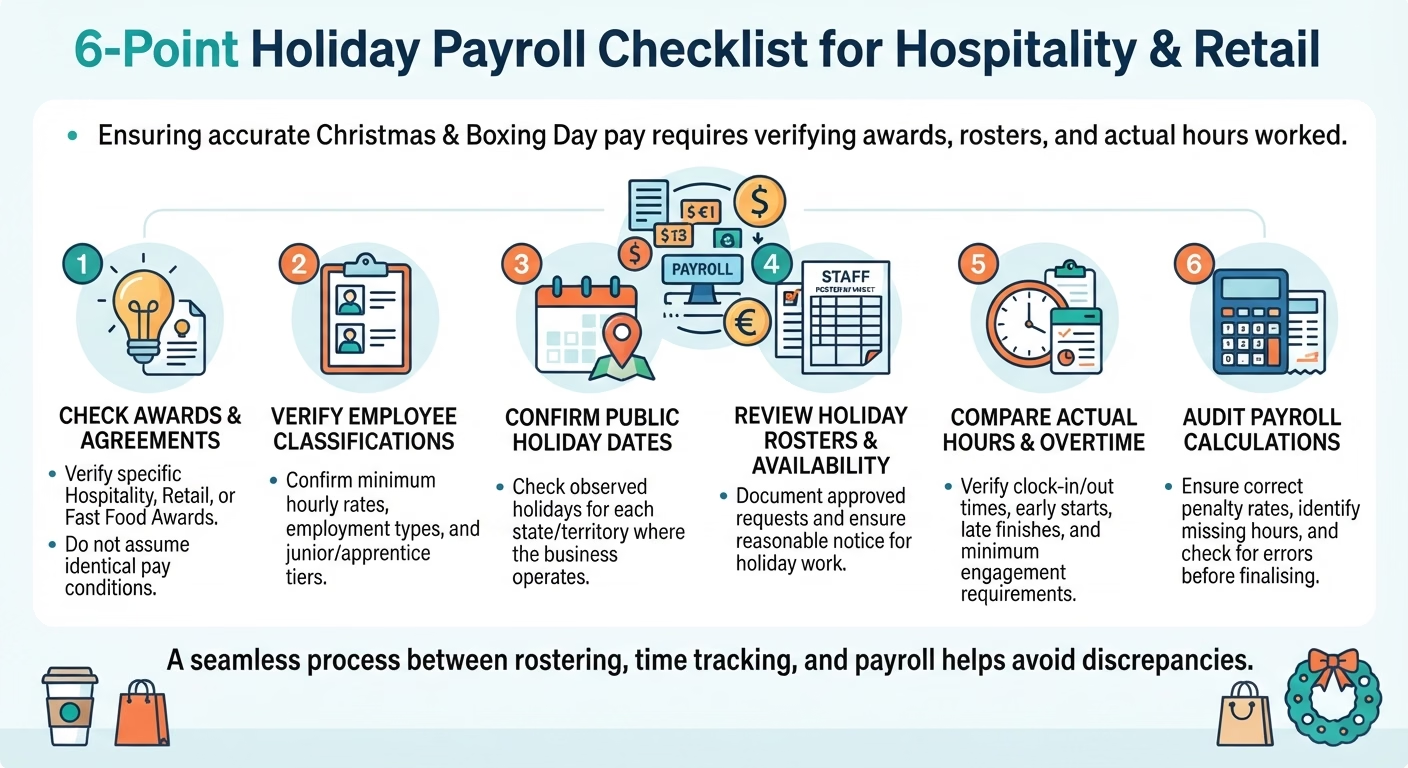
6 things hospitality and retail employers should check before the holiday pay run
Getting Christmas and Boxing Day pay right requires more than entering a public holiday rate into payroll. Employers need to check the employee’s award, classification, roster and actual working hours.
Manage Christmas and Boxing Day payroll with Workstem
Managing public holiday pay becomes more complicated when employees work across different locations, award classifications, employment types and shift patterns.
Workstem brings rostering, time and attendance, award interpretation and payroll together in one platform.
With Workstem, employers can:
- Plan holiday rosters: Schedule employees across locations and review projected labour costs before publishing shifts.
- Track actual working hours: Capture employee attendance and compare actual hours against scheduled shifts.
- Apply award pay rules: Configure ordinary hours, overtime, public holiday penalties and other applicable award conditions.
- Connect approved timesheets to payroll: Use verified attendance and approved timesheets as the basis for payroll calculations.
Instead of managing holiday rosters, attendance records and pay calculations across separate systems, employers can review the workforce process in one place.
Simplify the way your workforce operates and manage everything together in one place. Explore more today.
Frequently asked questions
- What is the Christmas Day pay rate in Australia?
There is no single rate for every Australian employee. Under the Hospitality Industry Award, Restaurant Industry Award and General Retail Award, ordinary hours worked on Christmas Day are generally paid at 225% for full-time and part-time employees and 250% for casual employees.
- What is the Boxing Day pay rate in Australia?
Under the same awards, ordinary hours worked on Boxing Day are generally paid at 225% for full-time and part-time employees and 250% for casual employees. Employers must also check whether an additional or substitute public holiday applies in their state or territory.
- Do casual employees get paid extra for working Christmas Day?
Yes. Casual employees covered by the awards discussed in this article generally receive 250% of the minimum hourly rate for ordinary hours worked on a public holiday. This rate already includes casual loading.
- Do employees get paid if they do not work on Christmas Day?
Full-time and part-time employees are generally entitled to their base pay rate for the ordinary hours they would normally have worked on Christmas Day. Casual employees generally do not receive payment if they do not work on the public holiday.
- Do employers have to pay both Saturday and Boxing Day penalty rates?
Not automatically. Public holiday rates are generally treated as a separate penalty rate rather than being added to the usual Saturday rate. Employers should check the applicable award or enterprise agreement to confirm how overlapping penalties are handled.
- Do public holiday rates apply to overtime on Christmas Day or Boxing Day?
Overtime on a public holiday can attract a different rate from ordinary public holiday hours. For example, under the General Retail Award, public holiday overtime is 250% for full-time and part-time employees and 275% for casual employees. Always check the relevant award’s overtime provisions.
- Can an employer ask employees to work on Boxing Day?
Yes, an employer can make a reasonable request for an employee to work on a public holiday. However, employees can refuse if the request is unreasonable or they have reasonable grounds for refusing.
- Does an employee receive a paid day off if Christmas Day falls on their usual day off?
Not necessarily. Under the NES, full-time and part-time employees are generally paid for public holiday hours they would normally have worked. If the public holiday falls on a day when they have no ordinary hours, they are generally not entitled to payment simply because it is a public holiday. Some awards and agreements provide additional entitlements, so employers should check the applicable rules.
Read more
Public Holiday Guides
Christmas Public Holiday Rates: Your Ultimate Guide
Award Guides
Hospitality Award 2026/27 – Pay Rates & Penalties (MA000009)
Retail Award Rates 2026/27: Pay, Penalties, Allowances & Classifications | MA000004