


If you work as a casual employee in Australia, you’ve probably noticed your hourly rate is higher than your permanent colleagues doing the same job. That extra pay is casual loading, and it’s a legal requirement.
Here’s everything you need to know about how casual loading works in 2026, what it covers, and what other casual employee entitlements you may still be owed.
What Is Casual Loading?
What: Casual loading is an additional percentage added to a casual employee’s base hourly rate to compensate for the entitlements they do not receive compared to permanent workers.
Who: It applies to all employees legally classified as casual under the Fair Work Act 2009.
When: It is paid with every shift and it does not accumulate over time like leave.
Where: The obligation applies nationally across all industries under Australian employment law.
Why: Casual employees receive no paid annual leave, no paid personal/carer’s leave, no paid compassionate leave, no notice of termination, and no redundancy pay. Casual loading compensates for all of these.
How: It is calculated as a percentage on top of the minimum base rate under the relevant Modern Award or enterprise agreement.
What Is the Casual Loading Rate in Australia?
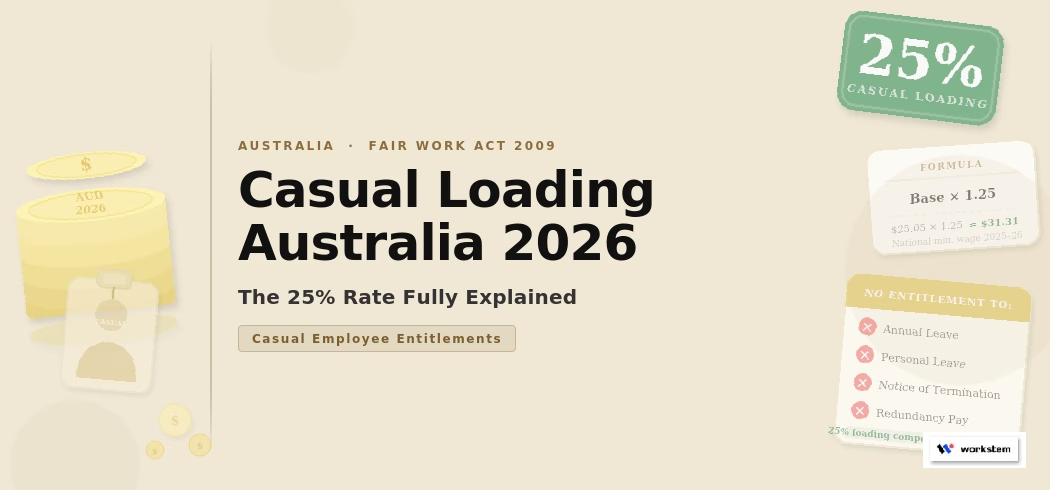
The standard casual loading rate is 25% for most Modern Awards and for employees covered by the National Minimum Wage.
As of 1 July 2025, the national minimum wage is $25.05 per hour for permanent adult employees. With 25% casual loading applied, casual employees on the national minimum earn $31.31 per hour.
Formula:
Casual rate = Base hourly rate × 1.25
Example: If the permanent award rate for your classification is $26.00/hr, your casual rate is $26.00 × 1.25 = $32.50/hr.
Note: Some awards may specify different casual loading percentages. Always verify the rate in your applicable Modern Award via Fair Work.
Does Casual Loading Replace Penalty Rates?
No. Casual loading and penalty rates are separate entitlements that can apply at the same time.
If you work on a weekend or public holiday, you may be entitled to both casual loading and the applicable penalty rate. How they combine depends on your award:
- Substitution method: The penalty rate replaces the casual loading (you receive only the penalty rate).
- Cumulative method: Both are applied separately and added together.
Check your Modern Award for the specific calculation method that applies to you.
What Other Entitlements Do Casual Employees Have?
Casual loading does not strip away all entitlements. Under the NES and the Fair Work Act, casual employees in 2026 are still entitled to:
- Unpaid carer’s leave and compassionate leave
- Family and domestic violence leave (10 days paid, included in the NES for eligible casuals)
- Minimum engagement periods (usually 3 hours per shift under most awards)
- The right to request casual conversion to permanent employment after 12 months of regular work, under the Closing Loopholes reforms
Is 25% Casual Loading Enough?
Financial modelling suggests that permanent entitlements including 4 weeks paid annual leave with 17.5% loading, 10 days personal leave, notice of termination, and redundancy pay can be worth 30–35% of base salary over the long term. The 25% loading may not fully compensate for all foregone benefits, particularly for long-term casual employees who work regular hours.
If you’ve worked consistent hours as a casual for more than 6–12 months, it may be worth considering a conversion to permanent employment.
Key Takeaways
- Casual loading of 25% is mandatory under Australian employment law for all casual employees.
- It is designed to offset the absence of paid leave, notice, and redundancy entitlements.
- Casual loading does not replace penalty rates both can apply simultaneously depending on your award.
- Casual employees retain certain NES entitlements regardless of their casual status.
- After 12 months of regular work, casuals have the right to request permanent employment.
FAQs about Casual Loading Australia in 2026
Q1: Is casual loading mandatory in Australia?
A1: Yes. Casual loading is a legally required payment for all employees classified as casual under the Fair Work Act 2009. Employers must pay it regardless of how regularly the employee works. The standard rate is 25%, though the exact rate may differ under some Modern Awards or enterprise agreements. Failure to pay casual loading is a breach of the Fair Work Act and may expose employers to back-payment orders and civil penalties.
Q2: Do casual employees get penalty rates on top of their casual loading?
A2: Yes, in most cases. Casual loading and penalty rates are two separate entitlements and are not interchangeable. A casual employee who works on a Sunday or public holiday is generally entitled to both. The way they are combined depends on the specific award some use a substitution method (the penalty rate absorbs the loading), while others use a cumulative method (both are added together).
Q3: What is the difference between a casual and a part-time employee in Australia?
A3: The key legal difference is whether there is a firm advance commitment to ongoing work. A part-time employee has guaranteed, regular hours and is entitled to paid annual leave, personal/carer’s leave, notice of termination, and redundancy pay. A casual employee has no guaranteed hours and can have their engagement ended at any time in exchange for which they receive the 25% casual loading. Under the Fair Work Act (updated in 2024 via the Closing Loopholes Act), casual status is assessed on the real nature of the employment relationship, not just what the contract says.
Q4: Can a casual employee convert to permanent employment?
A4: Yes. Under the Closing Loopholes reforms (effective from 2024), casual employees who have worked regular and systematic hours for 12 months or more have the right to formally request conversion to permanent (full-time or part-time) employment. The employer must respond in writing within 21 days and can only refuse on genuine business grounds, such as the role changing or the employee’s hours being genuinely irregular. Employees can dispute a refused request through the Fair Work Commission.
Q5: Does superannuation apply to casual loading?
A5: Yes. Casual loading is treated as part of an employee’s ordinary time earnings (OTE) for most shifts, which means the 12% Superannuation Guarantee (the rate for the 2025–26 financial year) applies to it. Superannuation is calculated on the gross rate paid, including the casual loading component, for ordinary hours worked. Note: super obligations may differ for certain penalty rate payments depending on whether they are classified as OTE employers should confirm with their payroll provider or the ATO.
Read More
Casual Work Overview
How to Calculate Leave Entitlements for Casual Workers?
All you need to know: Casual Employment Information Statement (CEIS)
Understanding Casual Employment Rights in Australia
Can You Decline Shifts as a Casual Employee?
What Differentiates Casual Employees from Part-Time Employees?
Leave Entitlements Guide
Tax and Superannuation for Casual
Casual Employment and Superannuation: What You Need to Know
Casual workers: Are You Paying Tax Correctly?